
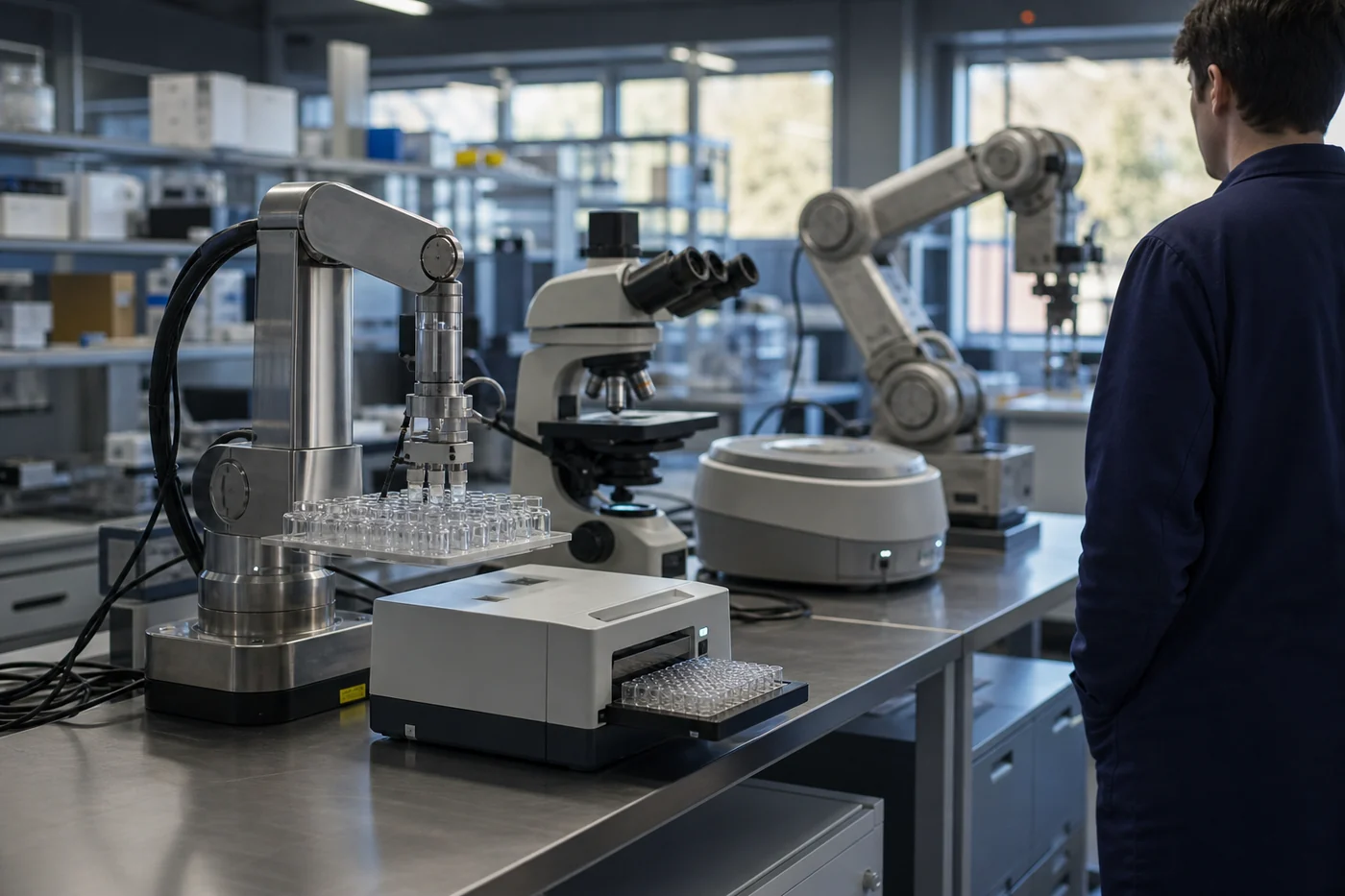
The expensive part is often the translation
MHS is a research preview, not a finished industry standard. Anthropic says it began with HHMI Janelia Research Campus and is being tested with scientific labs and advanced manufacturers before an open-source release. Its basic move is to make device capabilities legible in a common format: a machine can expose a temperature to read, a limit on what may be written, and the plain-language context an experienced operator normally keeps in a manual or in their head.
That matters for AI agents in laboratory automation because the alternative is usually an integration built for one instrument, one protocol and one local expert. A standard interface may shrink that setup work from weeks to hours or minutes, according to Anthropic. That is the vendor's claim, and it will vary sharply by device, safety requirements and the quality of the local driver.
The human benefit is not that a lab becomes hands-off. It is that a scientist might spend less time translating between machines and more time deciding whether the experiment is worth running.
A recovery rate needs its whole denominator
One early partner report gives a better kind of detail. QuEra says it used MHS on a dedicated testbed to help an AI agent recover and tune a laser system inside human-set safety bounds. Its post reports 695 successful on-target recoveries out of 700 trials across seven disturbance classes. Reported recovery times ranged from 0.9 to 5.4 seconds for wavelength-preserving faults, and roughly 10 to 14 seconds for the hardest faults; QuEra compares that with five to 10 minutes for a human expert.
Those numbers are promising, and they are not a general safety certificate. They come from one company's controlled testbed, a defined set of disturbances, a particular laser system and an outcome the company chose to publish. The useful part is the shape of the evidence: attempts, failure classes, a target condition, and a clear line between a lock that looks stable and one verified against an absolute wavelength reference.
For a buyer or lab manager, that is the standard to ask for. Not “did the agent recover?” Ask: recover from what, how often, into which confirmed state, and what did a person have to do after the result?
Make the first use case boring enough to inspect
The first deployment should not be a grand claim about an autonomous lab. Pick one bounded task: restart a known sequence after a harmless timeout, flag a plate transfer that failed a measurement check, or bring an instrument back to a documented safe state. Keep the old method available. Record every attempted action, the instrument state before and after, the reason for a stop, and the minutes a scientist spends checking the outcome.
Then test the awkward cases: an unavailable instrument, an out-of-range reading, a sensor that disagrees with the expected result, and a run that needs to wait for a person. The agent should make those cases cheaper to understand, not merely faster to produce.
The quiet win is a lab where more experiments can be set up without turning every new machine into a months-long software project—and where the evidence from a bad run is good enough that the next person does not have to start from zero.