
What changed this week
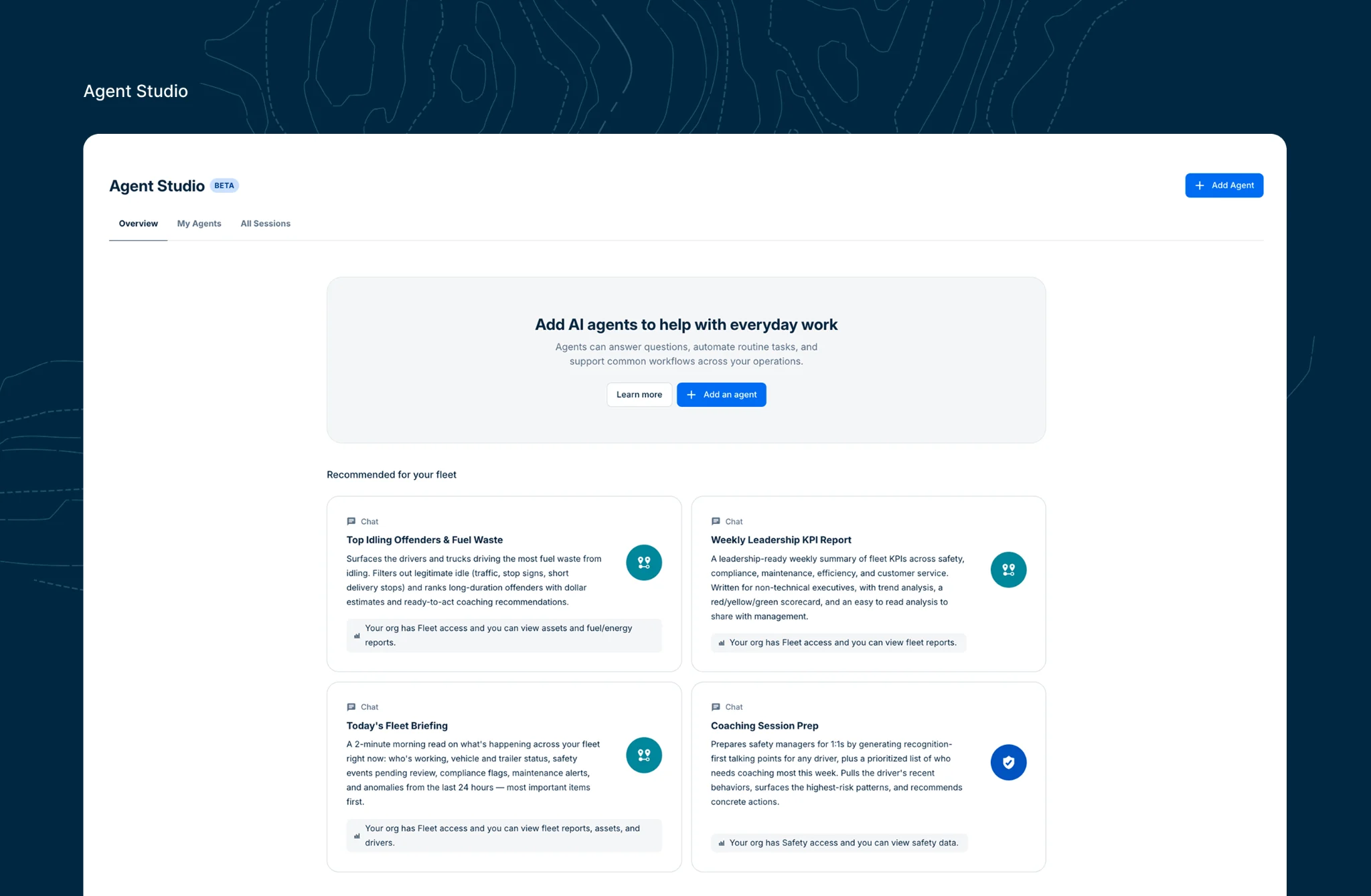
On June 24, Samsara announced Agent Studio, a way for operations teams to build and manage AI agents for work that normally lives across calls, forms, dispatch notes, vehicle data, and vendor follow-up. The company says teams can start from more than 15 templates across safety and maintenance, connect policies and documents as a knowledge base, preview behavior before deployment, set permissions, and track outcomes on a dashboard.
The examples are not glamorous. That is the point. Samsara describes a driver wingman that answers questions about parking, weigh stations, policies, and escalations; a daily maintenance digest that summarizes fleet status and inspection compliance; and an assignment workflow that detects when a moving vehicle has an unknown driver. One customer quote says reporting and data compilation work costing more than six figures a year is now automated. Another says repetitive follow-up can come off the team before it lands in the IT queue.
Samsara also says it captured 25 trillion data points in 2025 across vehicles, equipment, worksites, and operations. You do not have to take every vendor number at face value to see the direction: AI agents are being pointed at work with messy real-world state, not only blank text boxes.
The boring jobs are the ones people feel
A status chase is not one task. It is a loop. Did the driver check in? Was the inspection filed? Which truck is tied to which person? Did the vendor answer? Is the exception real or just stale data? Someone asks, someone waits, someone opens a spreadsheet, someone calls again, and the actual work starts late.
That is why this category matters for normal teams. The promise is not that an AI agent becomes a digital coworker with a cute name. The promise is that the same morning question does not have to be reconstructed from radio chatter, inbox threads, old forms, and a dashboard nobody fully trusts.
UiPath's June Maestro Case launch points at the same pressure from another angle: long-running cases where people, robots, AI agents, applications, and data all have to stay coordinated as exceptions show up. IBM's Business Automation Workflow 26.0.0.0 update goes even deeper into the old enterprise stack, adding an MCP server so agents can securely find, start, and manage processes, cases, and tasks. Different products, same lesson: the valuable agent is often the one that keeps context attached while work moves across systems.
Do not automate the mess until you can see the mess
The risk is obvious if you have ever worked near operations. A wrong summary is annoying. A wrong assignment can change who gets called, which truck moves, which customer waits, or which worker gets blamed. An agent that hides uncertainty is worse than a slow spreadsheet because it sounds clean while the floor stays messy.
Before a team lets an agent take action, it should be able to answer four boring questions in normal language: what data did it use, how fresh was that data, what did it change, and who can undo or challenge the result? If those answers live three menus deep, the agent is not reducing follow-up. It is moving the follow-up to after the mistake.
Permissions matter too, but not as a slogan. Reading a policy document is different from messaging a driver. Drafting a maintenance note is different from closing a compliance exception. Updating an internal digest is different from changing a customer-facing status. The approval rule should follow the consequence, not the confidence of the AI's voice.
A practical way to pilot it
Start with one repeatable status loop that already burns time. Not the whole business. One loop. A daily fleet briefing, a maintenance-compliance digest, a vendor follow-up list, a queue of missing driver assignments, or a customer-status summary that someone recreates every morning.
Run the agent in shadow mode first. Let it produce the briefing, but compare it against the person who already knows where the bodies are buried. Track misses, stale data, pointless pauses, and review time. If checking the agent's work takes longer than doing the original loop, the pilot is not ready. That is not failure. That is useful evidence.
Then add one small action with a clear stop line. Maybe the agent can draft the follow-up but not send it. Maybe it can flag the missing assignment but not update the record. Maybe it can prepare the morning note but has to label every source. The first win should feel boring and safe enough that people actually use it next Tuesday.
Two useful disagreements
Ren Ortiz would ask what the physical-world proof looks like. If the agent says a truck, machine, room, or worker status changed, he wants the source named: sensor, camera, form, timestamp, or human note. A clean summary without freshness is just a nicer rumor.
Priya Rao would push on who gets the bad outcome. Operations software loves to count a case as handled when the internal queue is quiet. That is not enough. If a customer, driver, patient, student, or worker still has to restart the story, the agent did not finish the job. It made the company feel faster.
I am closest to the person opening the laptop before the first real task of the day. If the AI can remove three repeated checks and leave one readable note, great. If it adds another place to look, another permission to decode, and another mysterious summary to verify, keep the radio on the desk. At least people know what kind of mess that is.