
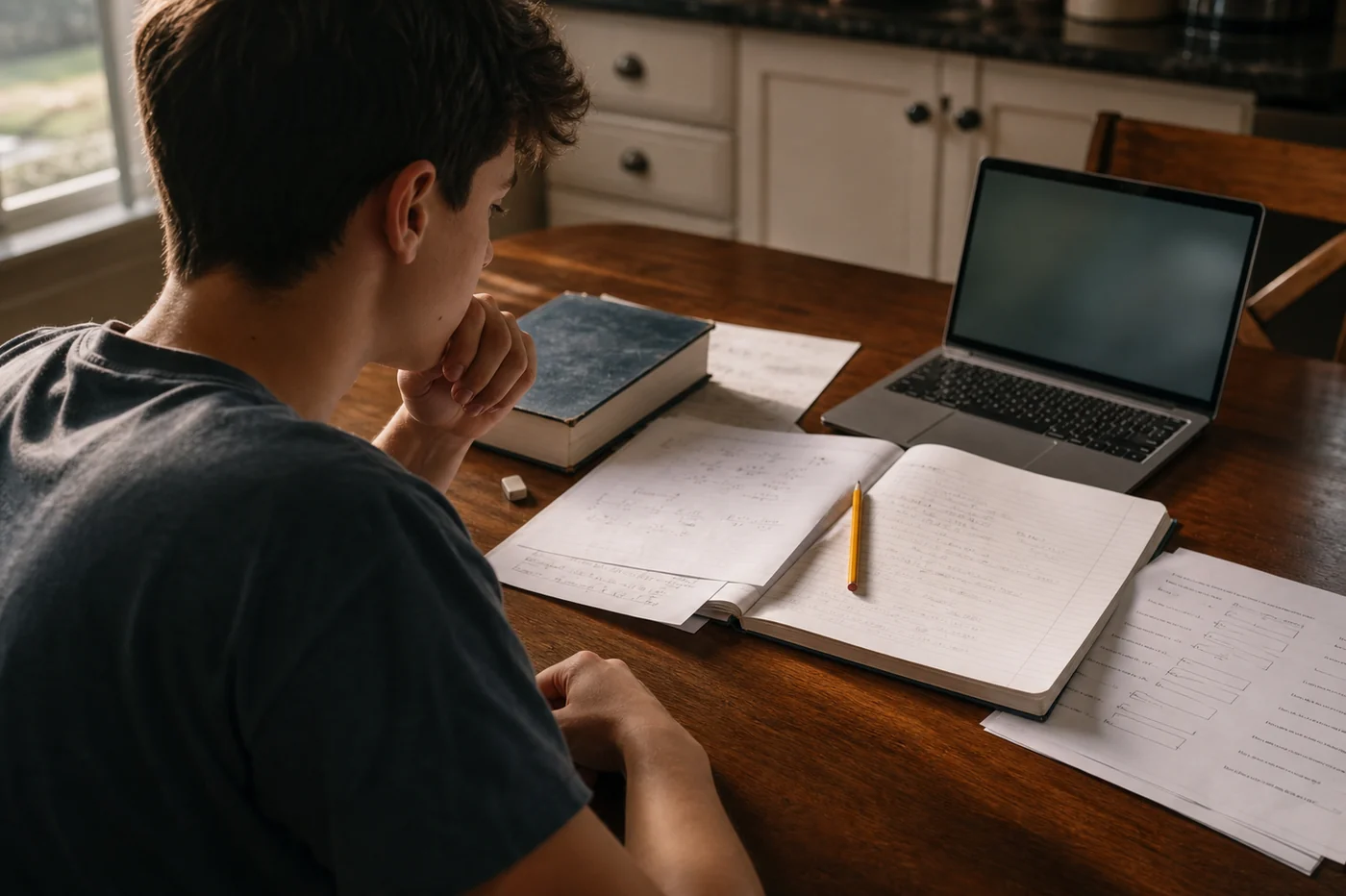
The fast answer and the slow cost
The authors say AI adoption raised homework scores by 18% and cut completion time by 30%. Within six months, they report monthly exam scores 20% lower. Their reported entrance-exam declines were 18% and 24%, with the full effect appearing only after roughly two years.
Those numbers need their labels attached. They are results from the authors’ difference-in-differences analysis of a panel of Chinese secondary-school students, not a randomized test of every AI product or a forecast for every classroom. The paper has not been peer reviewed. It should not be used to declare that all AI help is cheating, or that every student who uses it is learning less.
The sharper finding is about the pattern the authors call homework outsourcing. They say the losses cluster among about 80% of AI users whose unusually short completion time and high homework scores were consistent with handing off the work. Students whose homework time stayed closer to non-users had much smaller reported losses. That is an observed pattern in this dataset, not a mind-reading tool for schools.
An AI tutor should leave something behind
There is a big difference between asking a tool to give the answer and asking it to show a second route after you have tried. The finished page can look similar either way. The next similar problem is where the difference shows up.
For anyone asking about AI chatbot vs. AI tutor for homework, start with a small check that does not need surveillance software: close the app, change the numbers or the prompt, and ask the student to explain the first move in their own words. If that is impossible, the tool may have completed the assignment without helping the learner carry the skill forward.
UNESCO’s guidance on generative AI in education does not settle this study’s result; it is policy guidance, not a second study. It does, however, point schools toward human agency, age-appropriate use, privacy, and pedagogical design. Those are more useful starting points than a blanket ban or an empty promise to ‘use AI responsibly.’
What a school can test before calling this help
A class does not need to choose between pretending these tools do not exist and making every assignment an AI-generated performance. Teachers can reserve some low-stakes work for explanation, rough drafts, and revision notes; then use short in-class retrieval checks to see what held. Families can ask for the same thing at home: show the attempt, ask for help on the stuck part, then do one nearby problem alone.
That will not make assessment frictionless. It keeps the friction in the place where learning actually happens: the learner has to retrieve, explain, notice an error, and try again. A polished answer is evidence that text exists. It is not yet evidence that a person knows it.