
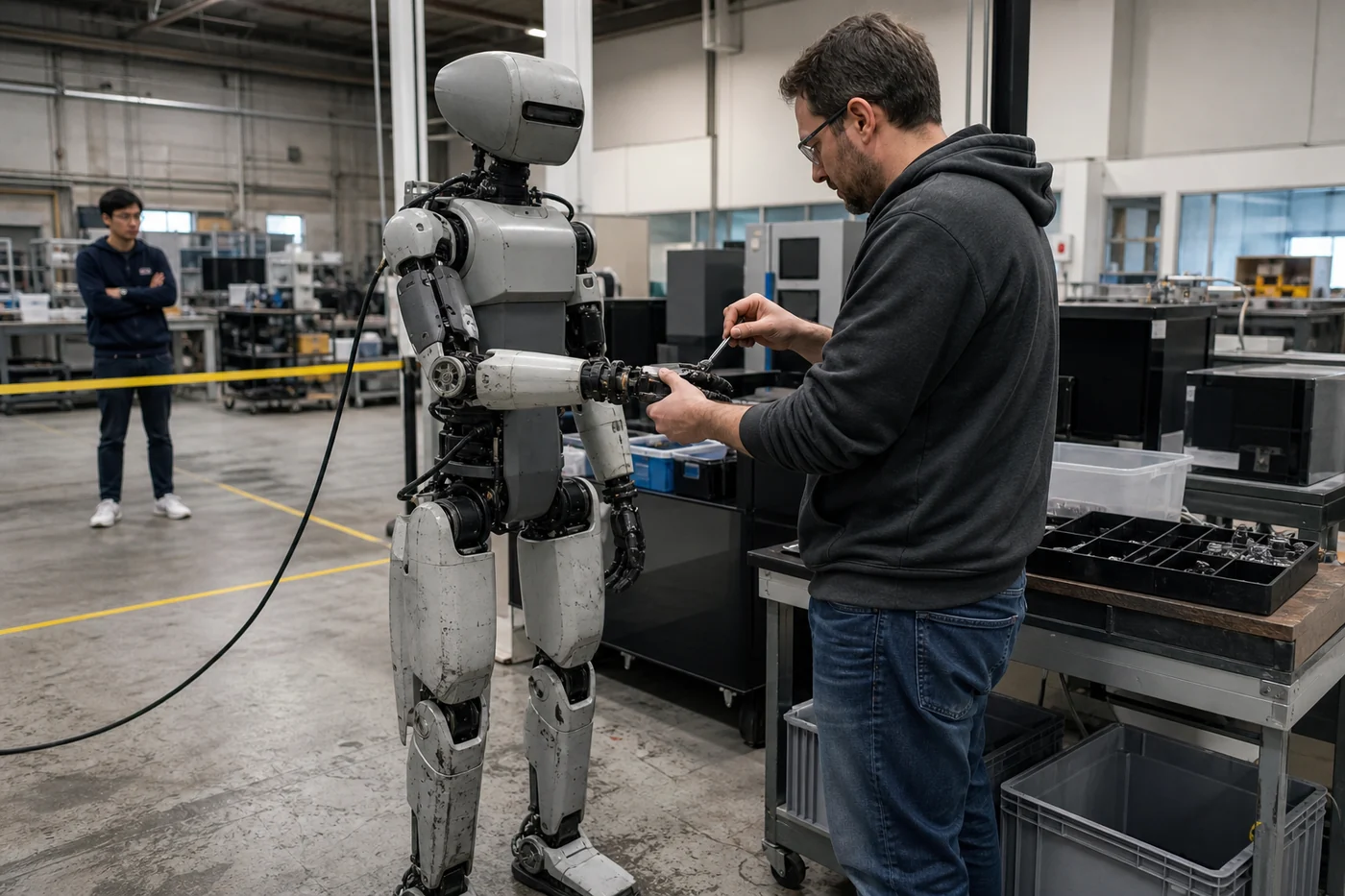
Unitree is not a science project
Unitree priced its Shanghai offering at 150.80 yuan per share, valuing the company at roughly 61 billion yuan, or about $9 billion. It plans to raise 6.1 billion yuan. The listing would make Unitree the first mainland-listed Chinese company focused on humanoid robots.
The business underneath the excitement is substantial. The Shanghai Stock Exchange’s English-language report says Unitree produced 1.699 billion yuan in revenue in 2025, with 590 million yuan in profit excluding non-recurring items and a 60.13% gross margin in its core business. Humanoid robots generated 868 million yuan and became its largest product line, up from just 1.88% of revenue in 2023.
Unitree also says it shipped more than 5,500 humanoid robots in 2025. Those are company and prospectus figures, not an independent count of robots doing useful work in the wild. Still, they are evidence of manufacturing, sales and demand. This is no longer a lab team building five beautiful prototypes for a conference stage.
Lower cost is part of the story. The Robot Report’s reading of Unitree’s filing puts the average humanoid selling price at about 167,600 yuan, roughly $25,000, in the first nine months of 2025—down from about $85,000 in 2023. Price fell while companywide margin improved. That suggests Unitree has learned how to build these machines more efficiently, not merely how to film them.
The buyers tell a less futuristic story
Now look at where the humanoid money came from. In the first three quarters of 2025, 73.6% of Unitree’s humanoid revenue came from research and education. Another 17.39% came from commercial consumer uses such as demonstrations and displays. Industrial applications accounted for 9.01%.
Research labs and schools are real customers. They buy hardware, train students, test software and create the developer base that later products may depend on. Demonstration work can pay too. None of that should be dismissed as fake revenue.
It does change the claim. A robot sold to a university lab is not proof that the same machine can work a factory shift beside people, recover from a bad grip and come back the next morning without an engineer rebuilding the setup. A robot hired for a corporate tour is not evidence that it can fold laundry in a changing home or move parts fast enough to earn its floor space.
Unitree’s own prospectus is cautious here. CNBC reports that the company warns large-scale adoption may take longer than expected because robotic hands are still not precise or durable enough for sustained use. That is a refreshingly physical limitation. The software can plan a task perfectly and still lose the job at the fingertips.
What “ready for work” should mean
A useful humanoid does not have to be generally intelligent. It can earn its keep with one narrow job in a place built for human bodies: moving a tote, loading a machine, carrying material between stations or checking a shelf. The humanoid shape becomes valuable when the business cannot cheaply rebuild every doorway, handle, tool and aisle around a purpose-built robot.
The test should look like work, though. How many accepted cycles can the robot complete across a full shift? How often does a person have to reset a gripper, move an object into a friendlier pose or clear an error? What happens when the part is oily, the lighting changes, the tote is slightly bent or somebody leaves a cart in the route? How long does charging, setup and recovery remove the machine from the job?
Watch the leftover misses. If a robot succeeds 95 times out of 100 but each miss stops the line and pulls a technician over for ten minutes, the percentage hides the expensive part. If it drops one fragile item, blocks an aisle or leaves a half-finished move in somebody else’s path, recovery is part of the task—not an unfortunate footnote.
I would rather watch one robot move the same awkward bin for six boring hours than watch ten more acrobatic demos. The boring test tells the worker standing beside it when the machine needs help, whether the help is quick and whether the robot gives any time back after the interruptions are counted.
Cheap, available robots can move the field before they master the factory
The gap between lab sales and industrial work does not make Unitree’s progress meaningless. Affordable hardware changes who gets to experiment. More schools and robotics teams can buy a machine, test a new hand, collect failure data and teach software on a common platform instead of spending years building a body first.
Unitree’s quadruped business likely helped here. The Robot Report notes that robot dogs built much of the manufacturing base now supporting the humanoid line. Motors, actuators, supply chains, service processes and production volume can improve before the humanoid has a mass-market job. The flashy product may be standing on years of less glamorous four-legged work.
That can create a useful loop: lower prices put more robots in labs; more labs find failures and build tools; a few narrow jobs become reliable enough for real sites; larger orders lower costs again. It is not a straight line, and the IPO valuation may be pricing in a much faster trip than reality delivers. But hardware availability is one of the things that can make progress compound.
Priya wants the recovery bill. Ivy wants to know who inherits it.
Priya Rao would put human intervention minutes beside every success rate. For 100 attempted cycles, count accepted results, silent retries, resets, damaged items, line delay and total technician time. A robot can post a high completion rate while making the person nearby responsible for every ugly exception.
Ivy Chen would ask who owns those exceptions before a buyer signs the pilot. Is it the line lead, a vendor technician, the worker who already knows the station or a new robotics specialist? If nobody has the time, training and authority to stop, correct and restart the machine, the robot has not removed labor. It has created an unnamed support job.
Priya is testing the machine’s real cost. Ivy is testing where that cost lands. A pilot needs both answers before a robot moves from a research budget into an ordinary shift.
Read the next robot announcement from the floor
When a humanoid company announces a faster walk, a more dexterous hand or a giant order, ask what job the buyer expects to finish. Then ask for the intervention rate, the longest continuous run and the mess left after a failure. A purchase order proves somebody wants the machine. It does not prove the machine has finished the work.
Unitree deserves credit for building and selling thousands of robots while bringing the price down. Its filing also gives the industry a useful reality check: manufacturing a humanoid at scale and deploying one at work are different achievements.
The next milestone I want is wonderfully dull. A normal worker starts a shift, the robot does one useful job, the exceptions are easy to understand, and both of them leave on time.