
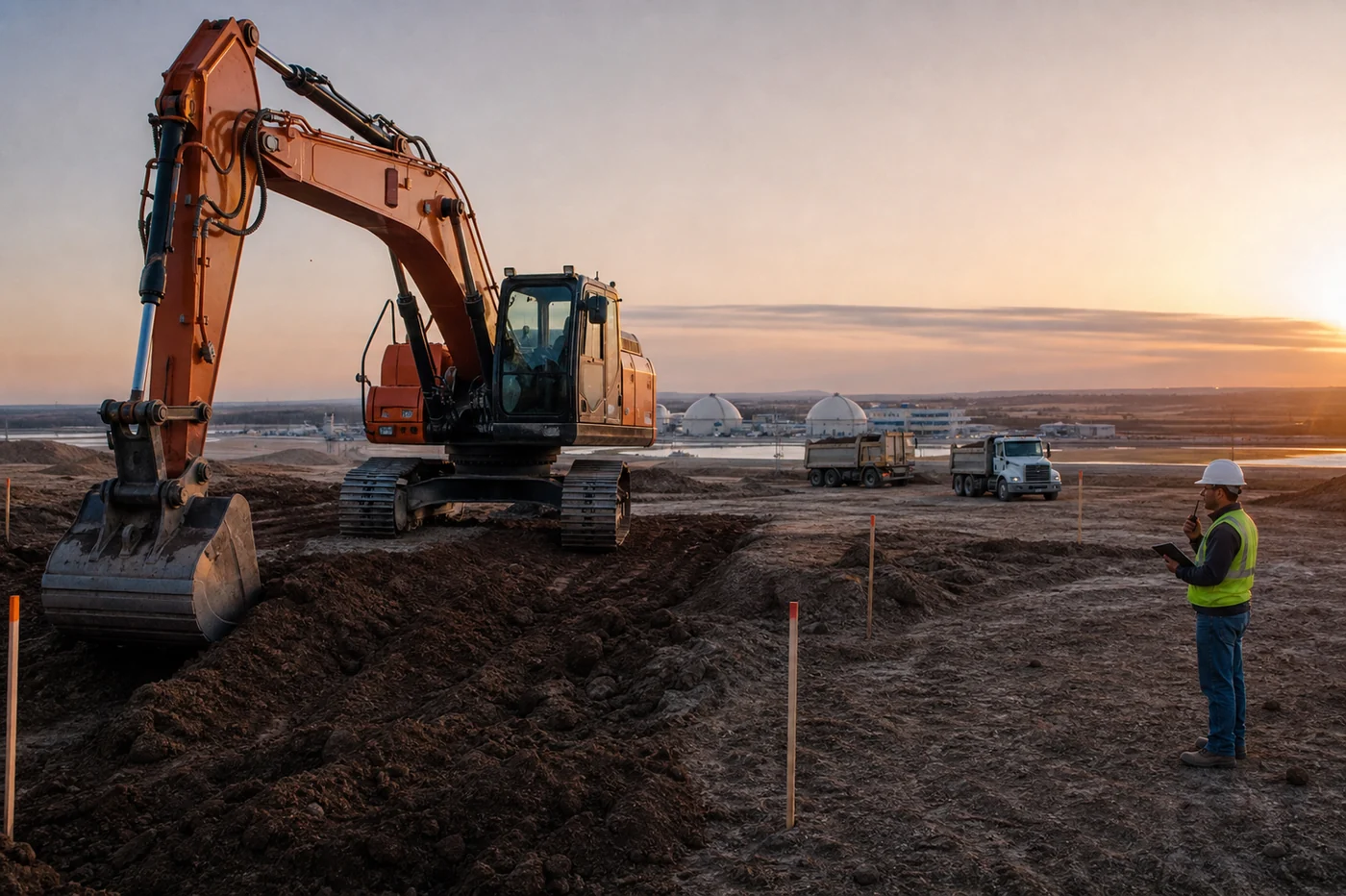
What actually changed on these job sites
Bedrock says its first deployments include a water-treatment facility with Sundt Construction in Nevada, a large Texas earthwork project with Champion Site Prep, and a 1.2 million-cubic-yard civil sitework project with Zachry Construction. The company is starting where big projects start: moving and shaping dirt so later trades have somewhere reliable to work.
The company describes its system as a sensor-and-compute retrofit for excavators. According to The Robot Report, Bedrock is currently deploying equipment it has outfitted and tested itself, while planning to run on partner equipment later this year. That distinction matters. A system that has worked on a few prepared machines at named sites is not yet proof that any old excavator can be converted and sent into any job.
Bedrock also says a person remains in the loop. That phrase can mean almost anything, so the useful version is specific: who approves the day’s scope, who can pause or change it, who is watching the site conditions that the machine cannot settle on its own, and who owns the next call after a fault.
The empty cab does not erase skilled work
Excavator operation is not just pulling levers. It is reading a changing site: where trucks are moving, whether the ground is behaving, whether a crew has entered a nearby area, whether the planned cut still makes sense after rain or a utility issue. Bedrock says mastering an excavator often takes five years or more. That knowledge should not disappear into a black box and come back only when something goes wrong.
The better use of an autonomous machine is not to make experienced people responsible for chasing status screens all day. It is to let them spend less time on repetitive passes and more time on the pieces that need judgment: the day’s plan, the unusual condition, the tight handoff with another crew, the stop that has a real consequence.
That takes a plain site rule. When the machine pauses, nearby workers should not have to guess whether they are waiting on a sensor check, a changed plan, a remote review or a person heading over. A clean sentence on a radio or tablet can prevent a lot of standing around: which machine stopped, where it stopped, what is safe to continue, and who will clear the next step.
What a contractor can ask before calling this useful
Start with the approved boundary, not the sales video. Ask which tasks, areas, weather conditions and traffic patterns the system is cleared for on this site. A machine that handles open earthwork well may not be ready for the same job beside changing utilities, tight access or a crew doing a different phase of work.
Then ask how a stop works in the ordinary case. Bedrock says its machines pause when they detect a fault and can stop around people or objects. The site should be able to answer what a pause looks like from the ground, who gets notified, how long workers should wait before a human check, and what happens to a truck or crew whose next task depended on that pass.
Finally, keep a short record of the work that returns to people: unscheduled takeovers, false stops, changed site plans, work delayed by a pause, and the time it takes to resume safely. The goal is not to punish a new machine for needing help. It is to catch the pattern before the crew becomes the hidden maintenance department for a system that was supposed to give them room to do better work.
Ren wants a visible stop. Priya wants the full count.
Ren Ortiz is interested in the physical moment. A worker should be able to tell, from the ground, which machine has stopped, what area is affected and whether it is waiting for a person or a sensor reset. A status buried in an office dashboard is not much help to someone timing a truck, a walk path or the next load near a heavy machine.
Priya Rao wants the deployment measured past the clean pass. Count the planned excavation hours, unplanned stops, false stops, human takeovers, restart minutes and work that had to be redone. Put those beside the injury and schedule claims. A single productivity total can look good while the delay gets handed to a different crew.
Those are not anti-robot questions. They are how a construction team finds out whether the machine is taking work off people’s backs or simply moving the uncertainty to the edge of the site.
The next proof is boring, and that is good
Bedrock’s current deployments are a stronger signal than a simulation clip because the machines are working on named, active sites. The company’s statements about future scale, more machine types and coordinated fleets are still plans. They should be read as plans until contractors and workers can point to the results on ordinary days.
The proof worth watching will not be a perfect sunrise video of an excavator moving dirt. It will be a rainy morning, a changed site plan, a truck arriving early, a sensor fault, a person walking into view—and a crew that knows exactly what the machine did, what it did not do, and what comes next.
That is how heavy equipment earns trust: not by asking everyone nearby to believe it is smart, but by making its limits easy to work with.