
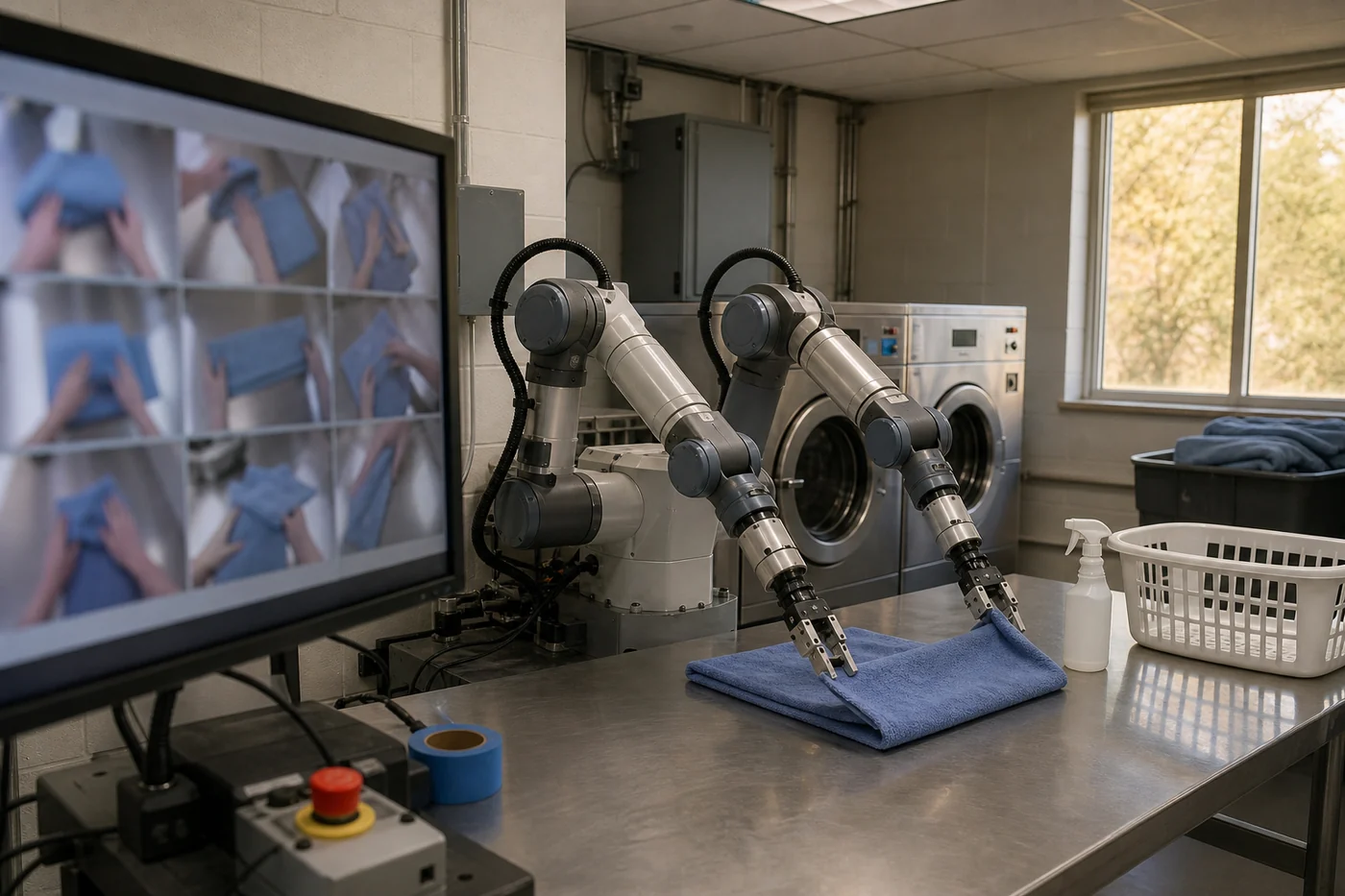
What DYNA-2 learns from a human video
Most robot training data is expensive because a person has to create it deliberately. Someone teleoperates an arm, wears a capture device or demonstrates a task in a setup built to record both motion and machine commands. The data is useful and precise. It also arrives one carefully produced hour at a time.
Dyna starts with a much larger source: head-mounted video of people already using their hands. Its public research page says the corpus contains more than one million hours collected by data partners and Dyna's internal operation. The footage covers ordinary manipulation in kitchens, workshops and living spaces. A processing pipeline cleans the clips, extracts 3D hand poses and converts wrist movement and the opening between thumb and index finger into rough action labels.
DYNA-2 is a world-action model. During training it learns to predict both what the next video frame should look like and what action follows. That joint job matters. A system rewarded only for the next motion can memorize a movement without learning much about what the movement does. Predicting the changing scene pushes the model to represent contact, object motion and the physical consequence of a hand moving through the frame.
The model does not simply copy a human hand onto a robot joint by joint. A parallel gripper, a five-fingered robotic hand and a pair of industrial arms do not share human anatomy. Dyna's claim is that the footage teaches reusable structure underneath the body: the bottle stays put unless something grips it, cloth bends instead of moving like a box and a pushed object can fall from an edge. Local robot data still teaches the hardware how to express that knowledge.
The strongest result happened before a robot moved
Dyna built nested training sets of 1,000, 10,000, 100,000 and one million hours while keeping the source mix constant. More human video improved the model's predictions on a separate 100-hour human validation set. Then the team gave the same checkpoints a held-out robot dataset the model had never seen during training.
That robot set contains 39 tasks on two stationary, two-arm platforms. It includes cloth handling, knot tying, packing, cleaning, food service and assembly. Twelve tasks came from Dyna's internal benchmark and 27 from an external XDOF dataset. Across the scale ladder, more human video produced better zero-shot robot-action predictions on all reported metrics.
This is careful evidence for transfer, with one important limit: most of it is offline. The model is being graded on whether it predicts recorded robot actions, not whether a live machine can finish a shift. A better action prediction is useful. It does not prove the gripper held the bottle, the towel landed in the right stack or a person stopped getting called over to reset the task.
The research also includes physical trials across 14 tasks and three kinds of robot body. The tasks ranged from hanging pants and scooping food to inserting a tube, turning a lockbox key and following a typed instruction to fetch a specific drink. The team reports ten trials per task, with 12 for the language-following test, and says the evaluators were not involved in model development. Performance rose as pre-training data grew.
Thirteen minutes with a bottle cap is promising, not a universal shortcut
The cleanest demonstration uses two robotic five-fingered hands. Dyna says 13 minutes of local data was enough to adapt DYNA-2 to untwisting a bottle cap. Other physical examples required hours rather than weeks of task-specific collection. That is the practical promise: the robot learns the broad shape of physical behavior from human video, then needs a smaller lesson for its own body and workplace.
Dyna also reports that DYNA-2 beat its earlier DYNA-1 model in matched physical tests, recovered from some disturbances that left the earlier system needing a reset and reached an 87 percent quality pass rate at an unnamed customer site versus 46 percent for DYNA-1. Those figures all come from Dyna. The company has published a long technical account, which is better than a demo reel alone, but the model, full dataset and customer protocol are not available for an independent team to reproduce end to end.
The field already had evidence that first-person human video can help robot learning. NVIDIA's EgoScale project trained on 20,854 hours and found a log-linear relationship between human-data scale and prediction loss, followed by better dexterous-hand performance after additional alignment. DYNA-2 extends the bet to a million hours and reports zero-shot transfer into held-out robot data. It is a serious step. It is also an industrial research claim awaiting outside replication on shared hardware and tasks.
Do not turn one quick bottle-cap lesson into a promise that any home chore can be taught over lunch. A cap has a narrow goal and a convenient reset. Laundry, food preparation and work around people have mixed objects, interruptions, hygiene rules and many ways to be almost finished while still leaving a mess.
A robot should not inherit every part of the demonstration
Human video contains more than the intended skill. A worker may brace a drawer with a hip because the slide is broken. A cook may use a temporary shelf that disappears after service. Someone folding laundry may protect a damaged shoulder, work around a child or place one customer's clothing in a special pile for a reason the camera never hears.
Scale can teach the common pattern while washing out the reason for an exception. Before a learned behavior reaches a workplace, the people who know the task should be able to name the target, the conditions that make the move safe and the details the robot must ignore. A smooth movement is not automatically the correct procedure.
The same issue applies to the footage itself. Dyna says most videos came from data partners and its internal operation, and it describes cleaning and hand-pose extraction in detail. The public research account does not name the source mix, recording locations, worker roles, consent terms, retention rules or whether the people in the footage can withdraw it. At a million hours, that is not paperwork around the research. It is part of the research infrastructure.
First-person cameras can capture coworkers, private rooms, screens, documents and improvised work that was never meant to become permanent training material. Any company building its own video library should settle who is recorded, who is paid, what gets excluded and how a person challenges a clip before celebrating cheaper data collection.
What to ask when a robot says it learned from people
Ask what kind of human footage trained it and what kind of robot evidence followed. Hours of video, offline prediction, ten physical trials and months at a customer site are four different levels of proof. Keep the level beside the claim.
Ask what changed after local teaching. Which skill transferred before fine-tuning? How many minutes or hours came from this workplace? How many first attempts failed? Who reset the object, corrected the procedure and decided the result was good enough? The answer should describe the leftover labor as plainly as the saved labor.
Then watch one ordinary exception. Move the towel, swap the container, interrupt the task or introduce the harmless clutter that appears on a real Tuesday. The useful machine notices the mismatch, slows down and leaves the scene easy for a person to recover. It does not perform the remembered motion with more confidence.
A million hours of human video could help robots arrive less blank. That would be a genuine change. The people in those hours still need to remain visible: as data contributors, teachers, judges of the work and the ones who share the room when a prediction becomes motion.