
What Moxi 2.0 is supposed to fix
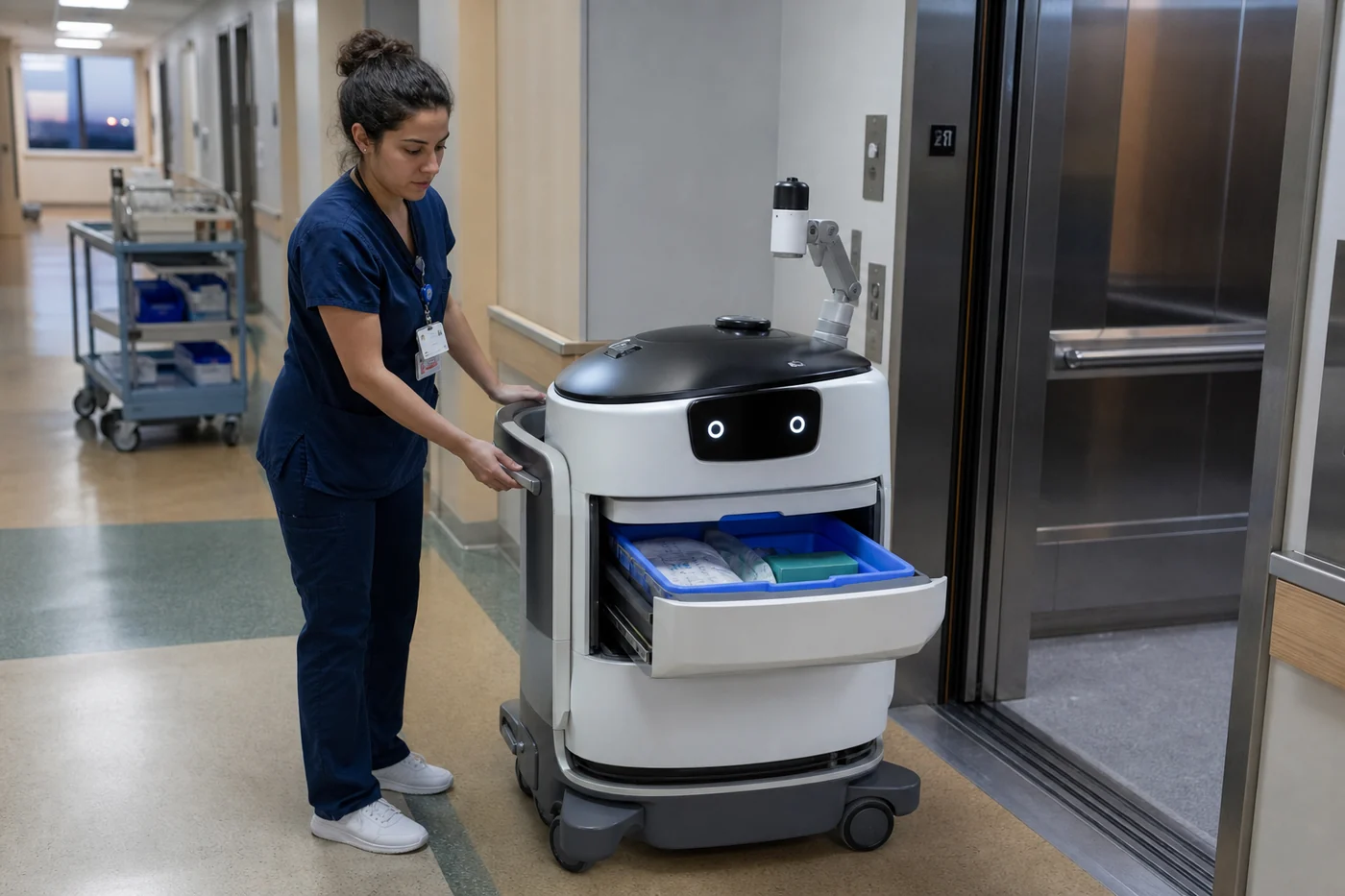
Moxi is a wheeled hospital delivery robot with an arm and secure storage. It moves medication, lab samples and supplies between departments, opens doors, calls elevators and releases protected items after a staff member scans a badge. It does not diagnose patients or replace bedside care. Its job is the walking.
Diligent says Moxi 2.0 is now going to Endeavor Health Edward Hospital, Providence Saint John’s Health Center and Children’s Hospital Los Angeles. The company says the platform was shaped by five years of operation in more than 25 hospitals.
According to the company’s launch release, the new robot has ten times the onboard compute and can interpret its surroundings 10 to 15 times faster than the previous version. It can run for up to nine hours at a time, charge 30% faster and operate for as many as 18 hours in a day. Cameras, sensors, storage drawers, handles and bumpers have also changed.
Those performance figures are company claims, not results from an independent hospital trial of Moxi 2.0. Faster perception should help when an elevator opens, a bed rolls across the route or a crowd changes direction. The number to watch is not how quickly the processor sees the problem. It is how often a staff member still has to leave work and help.
The first Moxi worked in some hospitals and failed in others
Diligent and AWS report that the existing fleet completed more than 1.3 million deliveries in 25 U.S. hospitals and returned more than 600,000 staff hours to patient care. Children’s Hospital Los Angeles has used two Moxi robots for pharmacy deliveries since 2022. In its first four months, the hospital reported more than 2,500 deliveries and 1,620 hours of staff time saved.
That is real use, not a trade-show lap. It is also mostly evidence reported by Diligent, its technology partner or participating hospitals. “Hours returned” usually converts a completed robot task into the time a person would otherwise have spent walking. It does not automatically subtract setup, monitoring, rescue calls, staff training or work that had to be repeated.
Proof News found the rougher side at MultiCare. Nurses at Good Samaritan and Tacoma General said Moxi got lost between floors, struggled with elevators and sometimes needed a human handler. One ICU nurse said staff avoided sending blood draws because a late sample could become unusable. MultiCare told reporters that utilization was not high enough to justify the cost and ended the program.
Diligent said those early deployments helped it improve elevator integration and other problems. That is a reasonable way to develop a robot, but the learning should not disappear into the next launch. Hospitals considering Moxi 2.0 need to see which first-generation failures were fixed, which still happen and how often.
A handle can be a bigger upgrade than an AI model
A nurse should not need to understand the robot’s software to know what it is doing. If Moxi stops near an elevator, the person beside it needs a plain answer: waiting for elevator three, yielding to a bed, route blocked, delivery safe, or staff help required.
The new side handles are revealing. In a perfect demo, nobody touches the robot. In a hospital, somebody will need to move it away from a bed, free a charging spot or guide it through an exception. A well-placed handle admits that reality and makes the recovery quicker. Larger curved drawers matter for the same reason: the supply bin has to fit, open and hand off cleanly while somebody is already busy.
Legibility matters before the rescue too. The staff member who requests a run should be able to see where the robot is, whether the item was loaded, who received it and when the job is late enough to take back. A generic “in progress” label is useless if a lab sample is circling another floor.
A June 2026 observational study in the Journal of Medical Internet Research found 78 barriers to bringing robotic technology into nursing work. The researchers concluded that robots are currently best suited to auxiliary and background jobs. Wider use depends on fitting clinical routines, working reliably with hospital systems and handling coordination and accountability. Carrying supplies is exactly the kind of background job a robot can earn. It still has to fit the building and the people inside it.
Ren sees a hard-won deployment. Cass sees a staffing claim that needs an audit.
Ren Ortiz gives Moxi credit for working in actual hospitals while many robotics projects remain demonstrations. His next test is physical: publish interventions per 100 deliveries, broken down by elevators, blocked routes, chargers and failed handoffs. A robot that learned from the hallway should be able to show where the hallway still beats it.
Cass Bell is less interested in aggregate “hours returned.” At MultiCare, nurses said they sometimes had to escort or rescue the robot, and the health system said usage did not justify the cost. Cass would count rescue minutes, abandoned jobs and human handlers beside completed deliveries, then ask nurses whether the extra time appeared at the bedside or vanished into another task.
Both views are useful. A million deliveries are meaningful evidence that the category can work. One discontinued 14-robot program is meaningful evidence that deployment counts can hide a bad fit. A hospital should not buy the fleet average. It should prove the route in its own elevators, corridors, pharmacy and lab.
How a hospital should test a delivery robot
Start with one boring route that happens all day and does not carry an item whose delay could immediately harm a patient. Map the ordinary trip and the ugly version: busy elevator, gurney at the door, network dead zone, blocked charger, missing recipient and drawer that was loaded incorrectly.
For four weeks, record completed deliveries, late deliveries, cancellations, human interventions and the minutes spent on every intervention. Separate planned implementation support from surprise rescue work. Ask the people who load, request, receive and walk around the robot; a dashboard can show that the job closed while the floor remembers who pushed it out of the way.
Then compare the full route with the old method. Did the medication or supply arrive sooner? Did the requester stay with the patient? Did pharmacy staff inherit more loading work? Did the unit reduce walking without adding another screen to watch? If the robot needs help, does the alert reach the right person with enough context to fix it once?
Set the stop rule before the pilot begins. If intervention time stays high, time-sensitive deliveries are avoided or staff stop requesting the robot, pause the route instead of calling low use an adoption problem. The robot is there to remove an errand. It should not require a campaign to persuade tired people that the errand is gone.
The useful hospital robot is almost boring
Moxi 2.0 does not need to look brilliant in the hallway. It needs to arrive, wait without blocking anyone, open the right drawer and leave. The nurse should see the delivery finished and move on without learning the robot’s moods.
Diligent has something most robotics companies still want: years of contact with real buildings, real elevators and workers who will stop using a machine that wastes their time. The first version produced both impressive delivery totals and a public failure. Moxi 2.0 is valuable if it carries both lessons forward.
Watch the first hospital reports for intervention rates, not another total-delivery counter. If the rescue calls fall and the deliveries stay dependable, the faster computer did its job. If nurses are still walking to the elevator, the robot is still borrowing the time it was sold to return.