
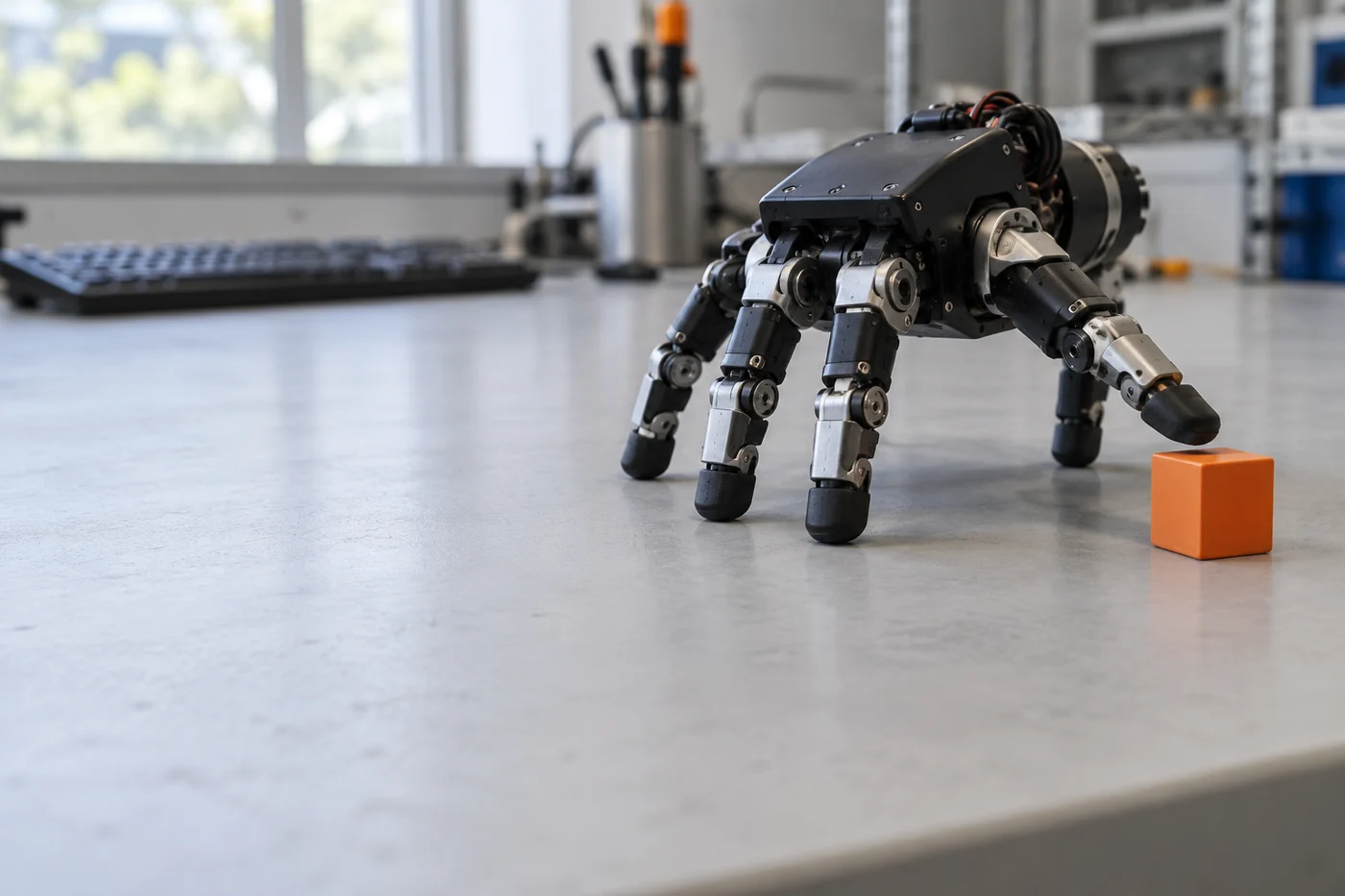
The fingers have to hold the robot up while they work
The team used an off-the-shelf WUJI hand, keeping its finger design and built-in joint controller. An added module supplies power, sensing and onboard computation. There are no wheels or separate legs: the fingers carry the hand, move it and interact with objects.
That is a harder balancing act than the shape first suggests. A thumb does not match a little finger. When one digit reaches forward, the remaining contacts have to support the palm. Pressing a key also takes a finger away from the support job.
The researchers trained movement through trial and error in simulation. Their training gives each fingertip a reference position suited to its own reach, with more freedom to step forward and backward than to drift sideways. The learned controller chooses which finger moves when. Crawling, fall recovery, keyboard pressing and object pushing use separate learned policies; this is not one general-purpose assistant deciding what a room needs.
A walking hand is not yet a hand that knows where to go
The project shows untethered crawling across 14 indoor and outdoor surfaces, including metal grating, grass and gravel. The paper labels those runs qualitative demonstrations. They show that movement can leave a single smooth bench; they do not establish reliable navigation through a cluttered workplace. Crawling commands came from a gamepad.
The fall-recovery test is more tightly counted: the hand got upright in 21 of 25 hardware trials across two fall directions. That is useful progress, with four unsuccessful attempts still in the picture. It is not a promise that a person will never need to retrieve it.
For object pushing, an overhead camera tracked the hand and a small cube. The paper presents 15 deliveries to targets as a demonstration. For keyboard work, an operator manually aligned the keyboard before each evaluation block, and misalignment required manual correction. The hand could execute operator-issued game moves through physical key presses; it was not independently figuring out the game.
Those distinctions explain the distance between a delightful clip and a tool someone can leave alone. The computer and battery travel with the hand. The camera arrangement, task setup and human direction do not all disappear.
There is room to be excited about an unfinished idea
The researchers suggest that a larger robot could place a mobile hand near a restricted opening, let it operate a control or move an object, then retrieve it. That is a proposed future use, not a completed field trial. IEEE’s reporting also identifies onboard perception, more robust navigation and durability under walking loads as practical questions.
Still, it is refreshing to see a body part given another job. A hand need not spend its whole life waiting at the end of an arm. The same hardware can become a little moving machine when the task calls for it.
For the person doing maintenance, the possible benefit is plain: less dismantling merely to get access, or less reaching into an uncomfortable space. Whether this design delivers either benefit remains to be tested. A smaller robot is valuable only if it reaches the job and comes back without making retrieval the hardest task of the afternoon.
What to look for in the next demonstration
If you are following this research, watch the project film alongside the paper rather than treating a short social clip as the whole result. Notice who gives the movement command, where the camera sits and what someone aligns before the hand begins. That makes the achievement easier to appreciate accurately.
A useful next trial would follow one harmless job from placement to retrieval in a confined workspace. Let the camera lose its view, let the hand slip, and show how someone gets it back. Those are proposed tests, not failures reported here.
Nobody needs to pretend this is ready for a home or a factory to enjoy it. A commercial hand has learned a way to get around that its designers did not give it separate legs for. I want to see what else becomes possible when we stop insisting every useful robot needs the rest of the body.