
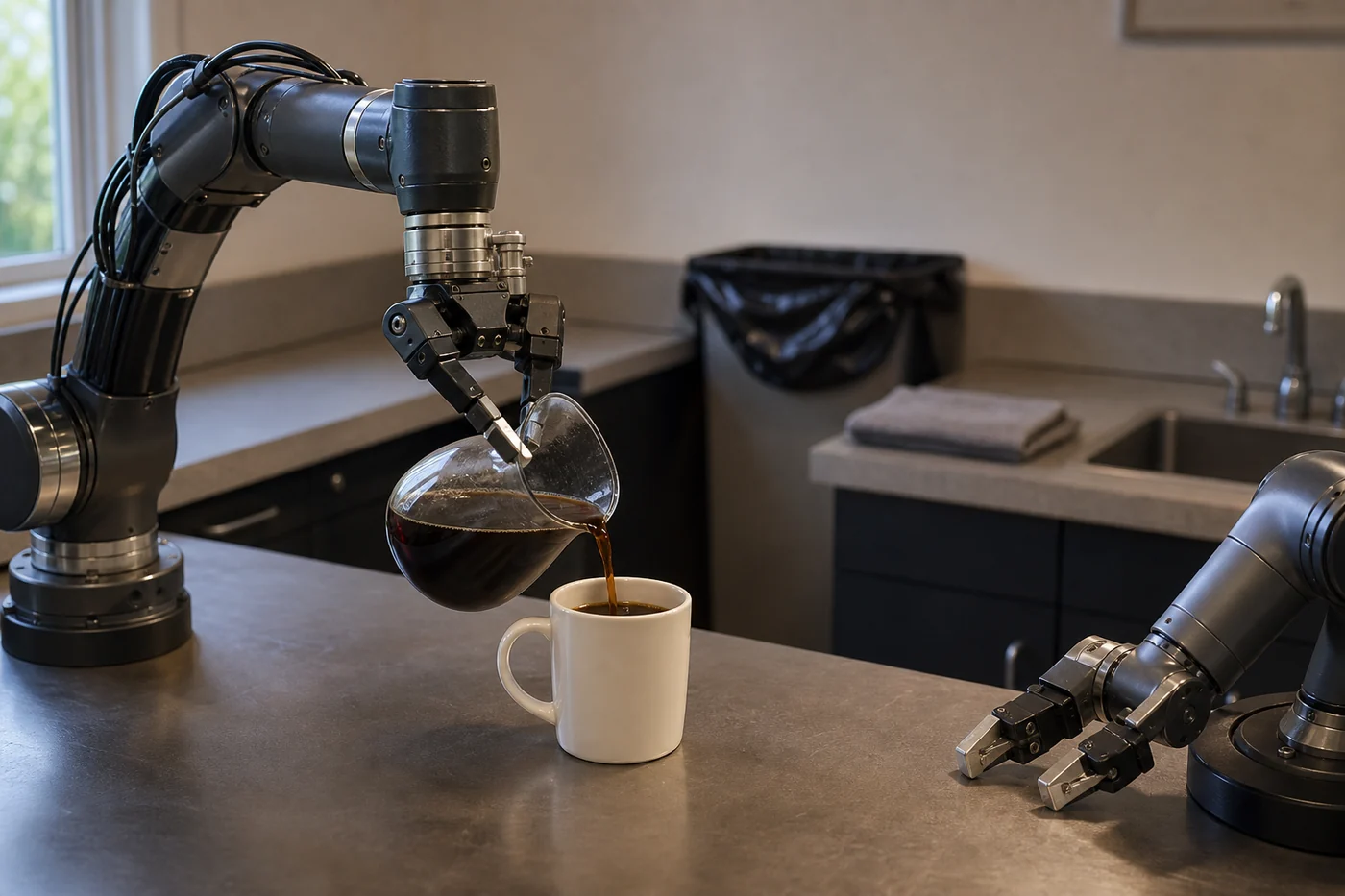
The missing verb in robot demos is ‘finished’
Most robot launches are built around visible action: walk to the shelf, grip the object, pour the drink, tie the knot. Gemini Robotics ER 2 sits above those motions. It takes a person's instruction, observes the room, plans the steps, and calls lower-level robot controls to carry them out.
The new piece is temporal understanding. Instead of judging one still image, the model watches the task through time. Google says it can detect a spill, slip, or misalignment during execution, retry the failed step, and continue without resetting everything.
That changes the ordinary value of a robot. A machine that begins a chore and waits for rescue has moved the work, not removed it. A machine that can tell ‘the bulb is tight,’ ‘the bag is tied,’ or ‘the cup is full’ has a chance of giving the person their attention back.
Google published a strong number and an awkward one
On moment-finding tests, Gemini Robotics ER 2 reached 91.3% accuracy with a mean timing error of 0.96 seconds. This test asks the model to locate the key frame when an event occurs, such as the instant it should stop pouring coffee. Google also says the model runs four times faster than the larger model class used for comparison.
Broader progress tracking is much less settled. Google divides each task video into five completion bands, from 0–20% through 80–100%. ER 2 classified those bands with 57.4% accuracy in the company's evaluation. Ars Technica described that as a clear improvement over the previous model, but still far from perfect.
Those scores measure different things, so they do not cancel each other out. The 91.3% result says the model is good at finding certain decisive moments in the tested videos. The 57.4% result says keeping a reliable running account of the whole chore remains harder.
All of these results come from Google. The release includes demos and internal comparisons, not an independent workplace trial. That does not make the numbers useless. It tells us what they are: a promising lab result and a much better question for the next demo.
A faster robot needs a better reason to pause
Google also introduced ASIMOV-Agentic, a benchmark that asks whether the reasoning model refuses unsafe robot actions, notices when a task cannot be completed safely, and asks a person for help when it is uncertain. In one company test, ER 2 stopped a humanoid when someone entered its working area and resumed after the person left.
That resume behavior deserves careful wording outside the lab. A person walking away does not always mean the scene is safe again. They may have stepped back because something slipped, jerked, spilled, or sounded wrong. Completion tracking and human-proximity detection are useful signals; neither should turn absence into automatic permission.
Google's own model card draws a hard boundary. It tells developers to use discretion in public, production, or commercial environments and bars the robotics models from safety-critical work in healthcare, transportation, and other settings where failure could cause injury or property damage.
This is the right tension to keep visible. ER 2 is available through the Gemini API and Google AI Studio, while the action models that move robots remain limited to early-access partners. Developers can try the reasoning layer. Buyers still need evidence from the actual machine, room, safety system, and task.
Ren watches the object. Mara watches the restart.
Ren Ortiz wants the completion claim to survive a plain physical check. After the robot says done, look at the cup level, the knot, the bulb, the object in its destination, and the mess left around it. A correct label over an unfinished scene is still unfinished work.
Mara Vale is more interested in the moment after uncertainty. If the robot pauses because a person entered or a step failed, what evidence allows it to resume? Her standard is blunt: leaving the area cannot quietly become permission to restart. The scene should be checked again, and the reason should make sense to someone standing outside the robot's reach.
Ren's question is whether the world changed correctly. Mara's is whether the machine earns the next move. A useful robot has to answer both.
How to test the next robot demo
Ignore the highlight reel for ten minutes. Ask the team to repeat one ordinary task 20 times. Move the cup. Swap the bag. Interrupt halfway through. Put an object in the wrong place. Have someone enter the work area and then step back.
Record four things: how often the task was actually complete, how often the robot declared completion too early, how many retries it needed, and how many times a person had to repair the scene. Keep the safety stop separate from the task score. A robot can finish the chore and still handle the room badly.
Then inspect the leftovers. Was the cup overfilled? Was the old bag still on the floor? Did the bulb stop at tight or at broken? Could a person see why the robot paused and what would happen next?
Robotics is getting better at the dramatic verbs. Walk. Grip. Pour. Tie. The next useful word is smaller: done.