
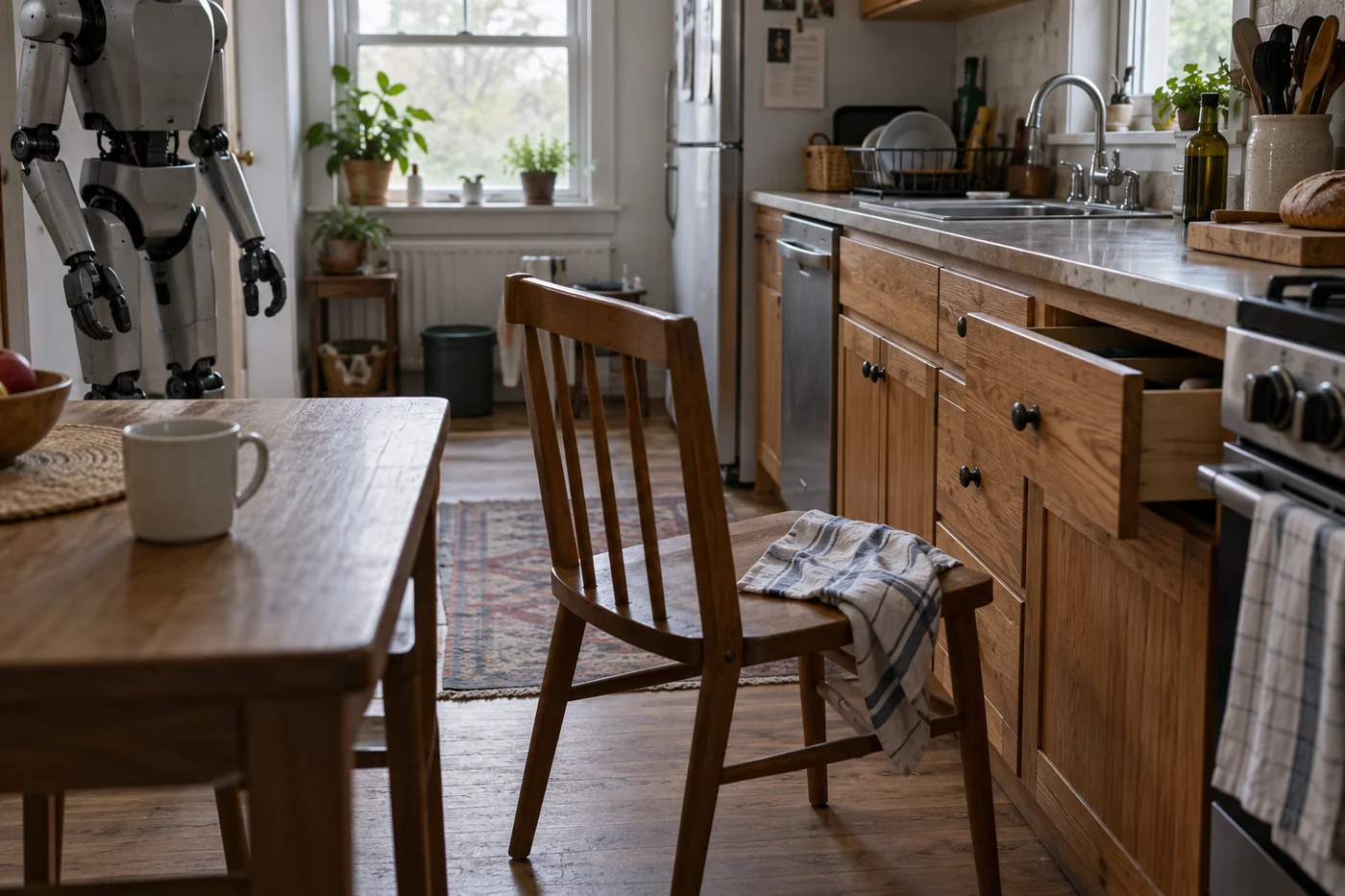
The cup is only part of the chore
Fetching something means getting close enough to reach it, arranging a stable stance, gripping it and moving away again. A robot can arrive at the right cabinet and still stand in the wrong place to open its door. That connection between walking and handling objects is what LocoManiLab studies.
The October 22 paper describes 234 task definitions across 13 simulated scenes in five categories: kitchens, living rooms, bedrooms, bathrooms and offices. Some tasks isolate a skill; others join two to four skills into one instruction. Twelve robot-control policies are compared using a shared whole-body controller, with a separate study examining controller choices.
The researchers distinguish familiar tasks, new tasks in familiar scenes, and new tasks in scenes held out of training. They also vary visual conditions. That lets them ask whether success survives changes, instead of treating one completed chore as the whole result.
An unfamiliar room is a harder promise
The paper reports substantial losses on unfamiliar tasks and scenes. Its unseen-scene test changes both the task definitions and the surrounding scenes. A low score there cannot be blamed on furniture layout alone; two kinds of novelty arrive together.
There is physical-robot evidence, but it is narrow. Three policies were tested on a Unitree G1 for fridge opening, carrying a cup from a shelf to a desk, and conveyor box handling, with ten hardware trials per task and policy. Their overall ranking matched the simulation ranking. Individual task results differed.
That is useful support for comparing systems in simulation. It is not evidence that these robots spent a week helping in occupied homes, nor a prediction of how often a particular robot would fail in your kitchen.
Ask how much of the house has to stay the same
For someone considering a home-robot trial, I would turn this research into a conversation about the allowed changes. Can you move the cup? Use a different cupboard? Leave a dining chair somewhere else? Does a changed room require another teaching session, or is it within the machine's documented limits?
These are questions for a supervised demonstration within the supplier's safety rules, not an invitation to put obstacles in a moving robot's path. Ask the demonstrator to show an unfamiliar but supported arrangement, and to explain what the machine does when it cannot finish.
A narrow job could still be worth having. Carrying the same lightweight item between two agreed places may help someone who finds that trip difficult. A fixed setup can be a fair bargain when everyone understands it. The trouble starts when a bounded skill is sold as though it will cope with whatever the household does next.
Leave room for people to live there
I like seeing walking, reaching and carrying tested together. That is closer to the help people imagine when they ask for a robot around the house. I also want the next round of evidence to include the effort of keeping that help available: reteaching, resetting and waiting nearby.
A household can reasonably make a few accommodations for a useful machine. It should know what those accommodations are before buying it. Being able to pull out a chair without arranging another training session seems like a good ambition.