
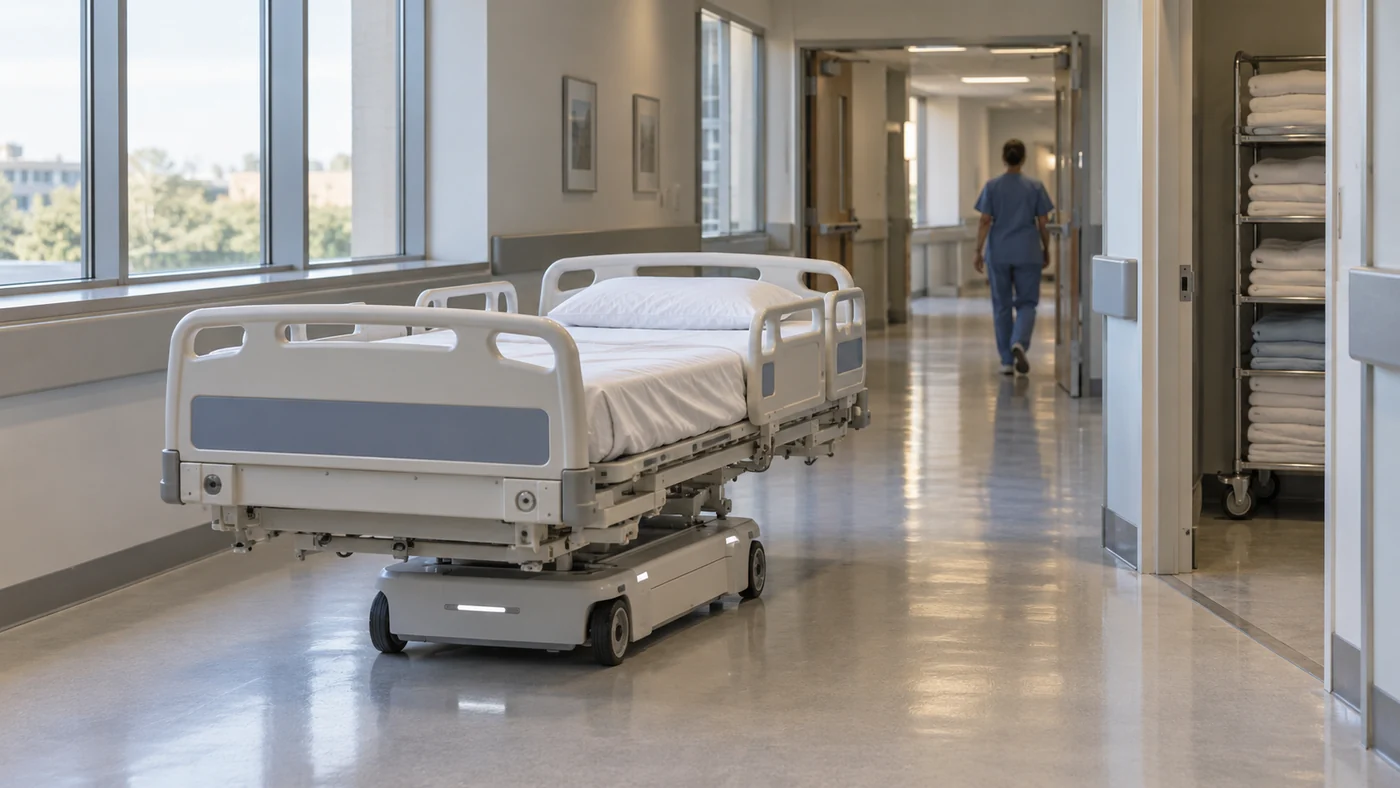
Start with the journey nobody wants to make
NEURA says its low, omnidirectional platform lifts empty beds and moves them between wards and floors after a single request. It can turn on its own axis, and the company says its safety functions remain active while lifting. Before deployment, the system is checked against a facility’s corridors, door widths and lift dimensions.
Those are company-described capabilities, not findings from an independent hospital trial. Still, the choice of job is sensible. A repeat trip between known locations gives a hospital something concrete to test before handing a robot more intimate work.
There is a useful boundary here, too. The launch announcement puts MiPA’s patient-room assistance and medication support in training and pilot environments. The broader product page describes those applications in more confident language. Readers should not fold that future into the empty-bed transport launch.
The bed arrived. Is it ready?
Imagine a bed reaching a storage area and the robot marking the move complete. That can be a perfectly successful trip while the next team still has questions: which bed is this, has it been cleaned, and can someone use it now? This is a proposed test for the system, not a failure reported in the announcement.
Transported, cleaned and ready are different facts. I would want the receiving team to see the destination and bed identity without hunting through an app. Cleaning status should come from the hospital’s actual process, not an AI guess based on an empty mattress or a finished journey.
Otherwise a machine can remove the pushing and leave the chasing intact. The helpful result is a bed the next person can find and correctly use, with any unfinished step obvious. That is less glamorous than navigation. It is also closer to why anyone would lease the robot.
Be careful with the hours-saved headline
NEURA says around 20 moves a day could give a facility more than 1,300 hours a year back for patient care. The announcement does not provide a named hospital’s measured before-and-after results or enough detail to reproduce that annual estimate. Treat it as the company’s business-case claim.
For a local trial, I would follow the people rather than only count the trips. How much time did staff spend arranging a move, getting the bed ready, waiting at a lift, responding to a stalled robot and confirming arrival? Whose time fell, and on which shift? Those questions keep one department’s savings from hiding another department’s new burden.
The answer could still be excellent. Repeated physical errands are worth removing even when the saving is smaller than the headline. But a completed journey does not tell you whether a nurse, porter or cleaner got a less rushed hour.
A monthly service needs a local fallback
The company plans to deliver the platform through partners at a fixed monthly rate covering integration, operation, maintenance, software updates and round-the-clock standby support. Its announcement names AURONIQ ROBOTICS as the integration and deployment partner. It does not disclose a price.
That arrangement could make the machine easier to adopt than a large equipment purchase. It also makes the service agreement part of the practical decision. Before a trial, staff need to know who responds to a stopped bed, how a safe manual recovery works and whether ordinary transport continues during an outage. Round-the-clock standby is not, by itself, a published on-site response time.
I would start on a limited route that staff actually want help with, agree on what success means with the people doing the work, and keep the normal transport path available. Expand when those people can name an errand they no longer have to make.
What would make this worth having
There is something encouraging about a robotics launch whose first job is carrying the awkward thing down the hall. Hospitals do not need every new machine to impersonate a caregiver. They need fewer reasons to pull a caregiver away.
For this one, I would want to hear a very plain verdict from the floor: the bed got where it belonged, nobody had to chase it, and the next person knew whether it was ready. That would be a good beginning.