
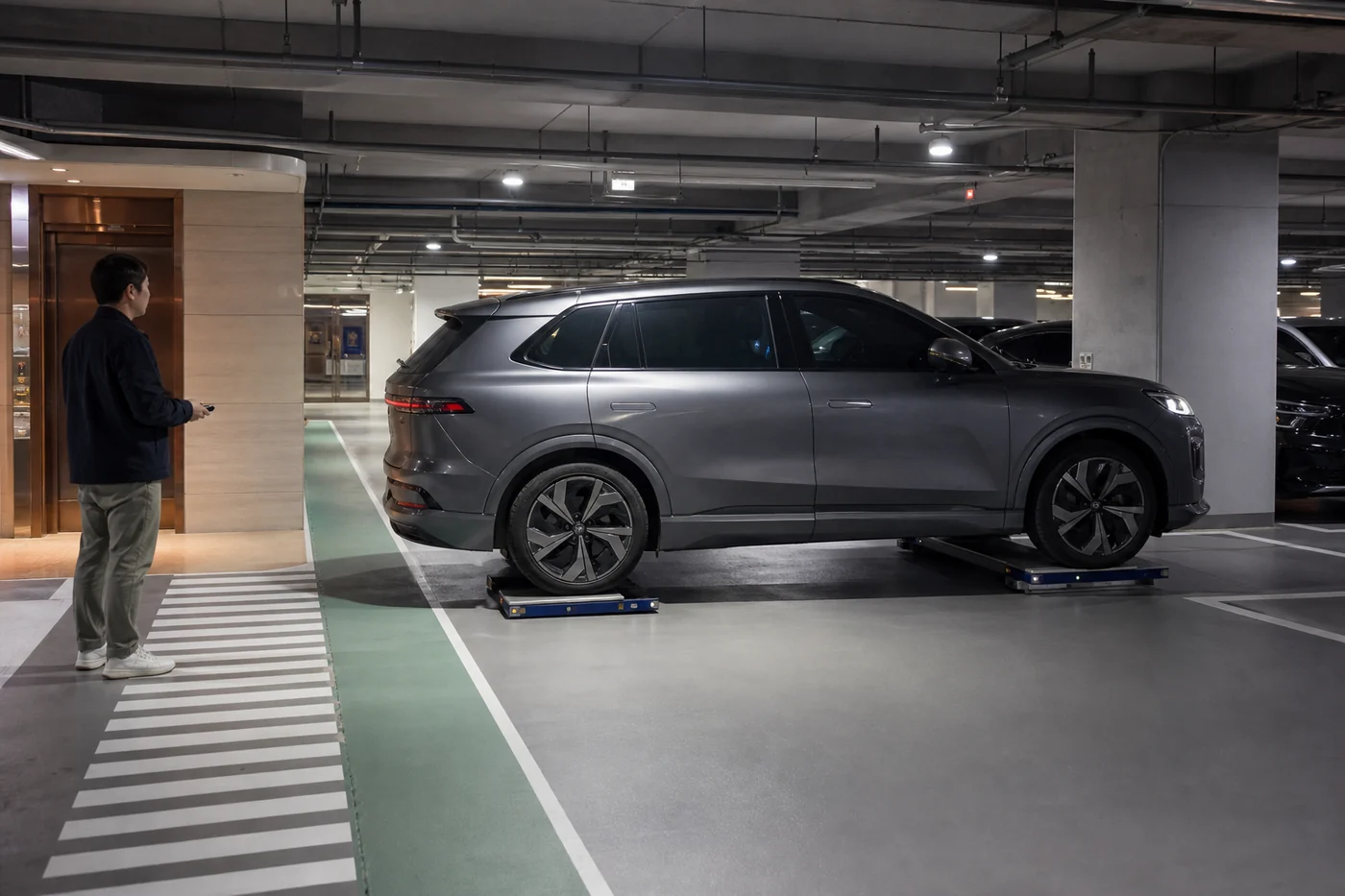
How parking robots work
Hyundai WIA’s system uses a pair of low, flat robots. LiDAR helps them locate the wheels, and attachments lift the front and rear axles. With the tires off the floor, the pair can carry the vehicle forward, backward, sideways or through a turn without steering it.
The company says each robot is 110 millimeters tall and a pair can handle vehicles weighing up to 3.4 tons at speeds up to 1.2 meters per second. That load rating matters as electric SUVs get heavier. Hyundai WIA says extremely low sports cars can still fall outside the system’s reach.
At the customer showcase, the machines moved a Genesis GV80 through a barrier, rotated it and placed it in a double-parked row. Aju Press timed one sequence—moving a double-parked vehicle and retrieving another—at two minutes and thirty seconds. It was a prepared demonstration, not a service guarantee, but the physical idea is easy to see: lift the wheels and the shape of the garage stops dictating every move.
The product is partly concrete, lanes and fire rules
A conventional garage gives up space to turning radii, door clearance and wide aisles. A robotic system can place cars closer together and stack them two or three deep because any vehicle can be moved without finding its owner first.
Hyundai WIA estimates that suitable layouts could hold 20% to 50% more cars. The range is wide for a reason. Columns, ramps, ventilation, fire lanes, pickup areas and the number of robot sets all take space back. A building does not gain fifty percent merely by buying two blue platforms and painting a tighter grid.
The economics may differ between a new tower and an old garage. New construction can shrink lanes and place pickup bays, power, network coverage and recovery access where the system expects them. A retrofit has to work around concrete poured for human drivers. Any capacity claim should show the final marked plan, not an empty rectangle divided by vehicle width.
The August showcase was a sales signal, not an apartment result
About 800 people from construction companies, contractors and housing groups attended Hyundai WIA’s August 19 event, according to the company and on-site reporting. South Korea also changed parking and housing rules in July to permit parking robots in residential complexes. Builders now have both a legal path and a product to price.
Hyundai WIA says its current control system can manage more than 50 robot sets and that a version for more than 100 sets is in development. It also wants the machines to move cars through automatic charging and washing services. Those are plans and company claims. The demonstration did not show a hundred robots recovering from one failed charger or clearing a garage during a fire alarm.
The company does have operating experience. It reports deployments at Hyundai sites in Singapore, Alabama, Georgia and South Korea, including 24 sets at one U.S. manufacturing complex. Factory miles matter, but a plant can standardize vehicles, routes and support in ways an apartment building cannot.
The September trial will test a residential garage before it tests residents
Hyundai Motor, Hyundai WIA and Hyundai Engineering & Construction plan to put two robot sets across a 53-space section at Hillstate The Wave City in Siheung. The 1,796-household complex is expected to receive residents next year. The project is due to start in September under South Korea’s smart-city regulatory sandbox.
That makes the trial useful for layout, lifting, routing, recovery and equipment testing inside a real apartment development. It does not yet show what occupied-building service feels like. There will be no moving truck blocking a lane, teenager borrowing the family car or resident discovering at 6 a.m. that a modified wheel is outside the supported range.
Keep the proof in order. First show that the robots can work reliably in the finished garage. Then show that the building can maintain them, clear emergencies and support the mix of cars people actually bring home. Only an occupied site can settle whether the extra spaces are worth the new dependency.
Mara wants the emergency key. Theo wants the claim kept small.
Mara Vale would ask who has authority to move a resident’s car when the normal system is down. A fire officer, building manager and vendor technician should not discover three different answers beside a loaded robot. The emergency procedure needs to name the person, the physical release and what happens if the network is gone.
Theo Marlow would keep three proofs separate: a prepared customer demonstration, prior operation at company facilities and the coming 53-space apartment trial. Together they show a serious product and a plausible new use. They do not yet show capacity gains or recovery performance in an occupied residential building.
Mara is looking for the moment the garage has to stop being smart. Theo is making sure the sales deck does not skip past the experiment. Both questions belong in the building contract, long before anyone hands over a car.
What a building board should price before approving robotic parking
Ask for the net space plan after pickup bays, fire access, robot charging, maintenance clearance and a disabled machine are included. Then list the cars the system cannot lift: weight, ground clearance, wheel geometry, damaged tires and common modifications. An extra space is not useful if it creates a second parking policy for everyone outside the supported envelope.
Price the service around the building, not only the hardware. Who responds locally? What parts are stocked? Can a trained building employee recover a car, or does every serious fault wait for the vendor? How is a vehicle moved when power or networking is unavailable? What insurance covers damage while nobody is driving?
Finally, separate construction savings from resident service. Tighter parking may reduce excavation or fit more homes into an existing footprint. That can be valuable even if the machine is never exciting again. But the building is trading concrete and maneuvering room for software, maintenance and a permanent recovery obligation.
I like the sideways move. It makes a familiar space feel briefly impossible. I would still want to see the garage with one robot disabled, one unsupported car at the entrance and the fire lane kept clear. Apartment technology becomes ordinary through that version of the day, not the demonstration where every car knows its cue.