
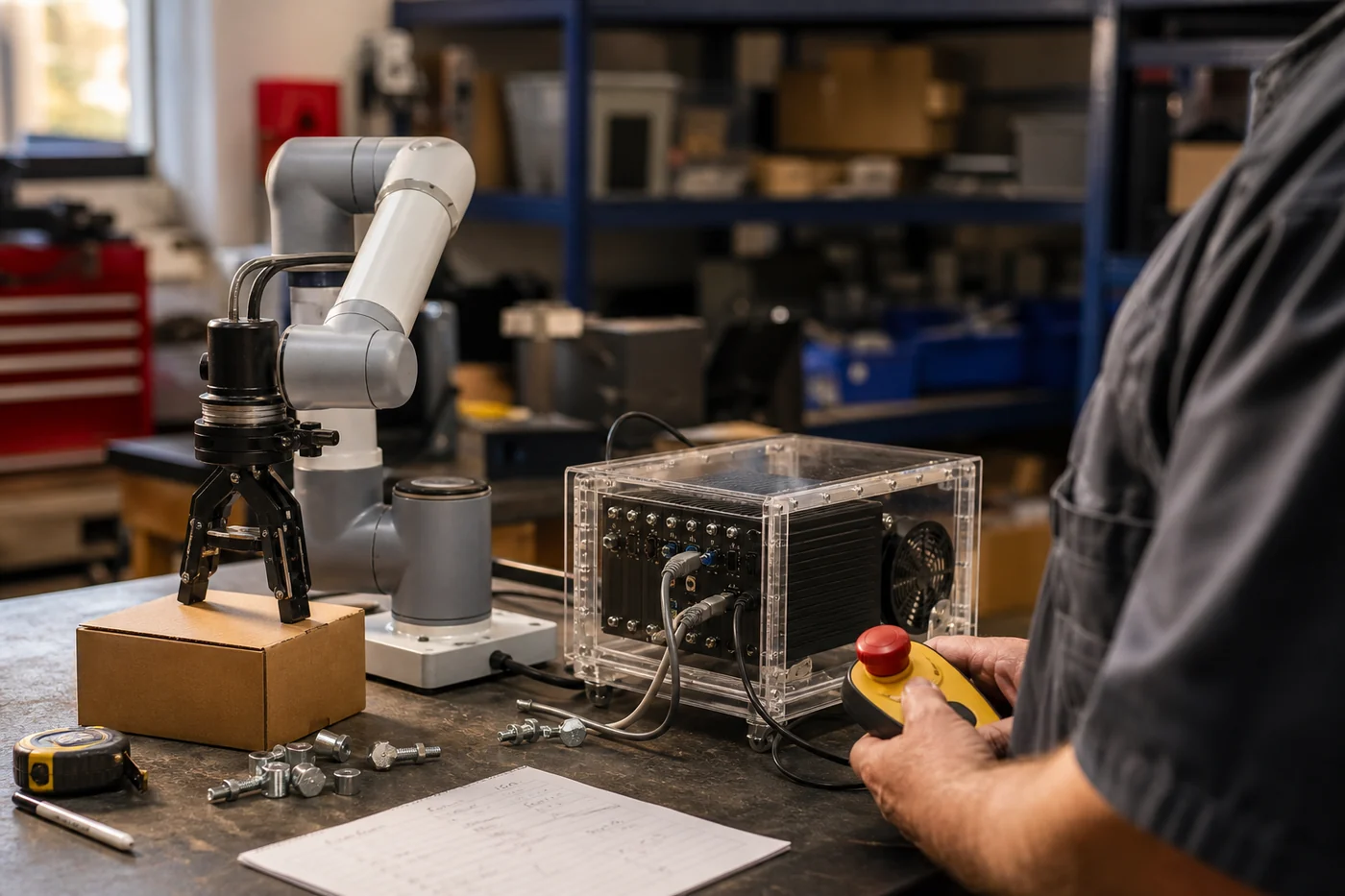
The price of trying just dropped. The price of being wrong did not.
NVIDIA's announcement is a vendor claim about a new product, not evidence that robots have suddenly mastered ordinary work. Treat it as a hardware availability story. Its practical value is that a student, a small shop, or a product team may be able to test a local robot idea without starting with a rack of expensive equipment.
That does not turn a cardboard box, a crowded counter, or a distracted person into a clean test environment. The robot still has to identify the object in front of it, act with the right amount of force, cope with a moved chair or a bad reflection, and stop before a small mistake becomes someone else's afternoon.
The useful question for a new low-cost setup is not, ‘What can it demo?’ Pick one job that a person already understands well: move these labeled bins from this shelf to that cart; check whether this loading bay is clear; bring this tray to the inspection table. Then define the boring parts first: where it must stop, who can take over, and what a failed attempt leaves behind.
A robot needs a small world before it earns a bigger one
The technical work behind robot navigation makes this plain. NVIDIA's recent COMPASS tutorial describes a path through environment validation, scene preparation, smoke testing, evaluation, and human approval gates before a policy is promoted. It is a vendor tutorial and a controlled reference workflow, not a guarantee of field performance. Still, the sequence is more honest than the usual magic trick: get one known setting working, inspect it, then widen the boundary carefully.
That is a good rule even if you never train a robot policy. Start with a route that has one destination, a limited speed, obvious obstacles, and a stop control somebody can reach without opening an app. Run it when no customer or family member has to absorb the consequences. Watch where the work gets weird. Only then decide whether the next version deserves another room, another object, or another hour of unattended time.
Cheap hardware is valuable when it lowers the cost of learning. It becomes expensive again when a team treats it as permission to skip the learning.
What to ask before you buy the robotics kit
If you are looking at entry-level robotics hardware, ask the seller or your own team for five concrete answers: What is the first job? What objects and spaces are out of bounds? What does a clean stop look like? What does the next person see after a failed run? Which manual process disappears if this works?
That last one catches a lot of bad purchases. A robot that adds a charging ritual, a camera-cleaning routine, an exception inbox, and a nightly recovery check has not returned time just because its demo finished quickly. It may be an interesting machine. It may even become useful. But somebody should be allowed to say those are different things.
The hardware announcement is a reason to pay attention to robotics. It is not a reason to pretend the work has become ordinary.