
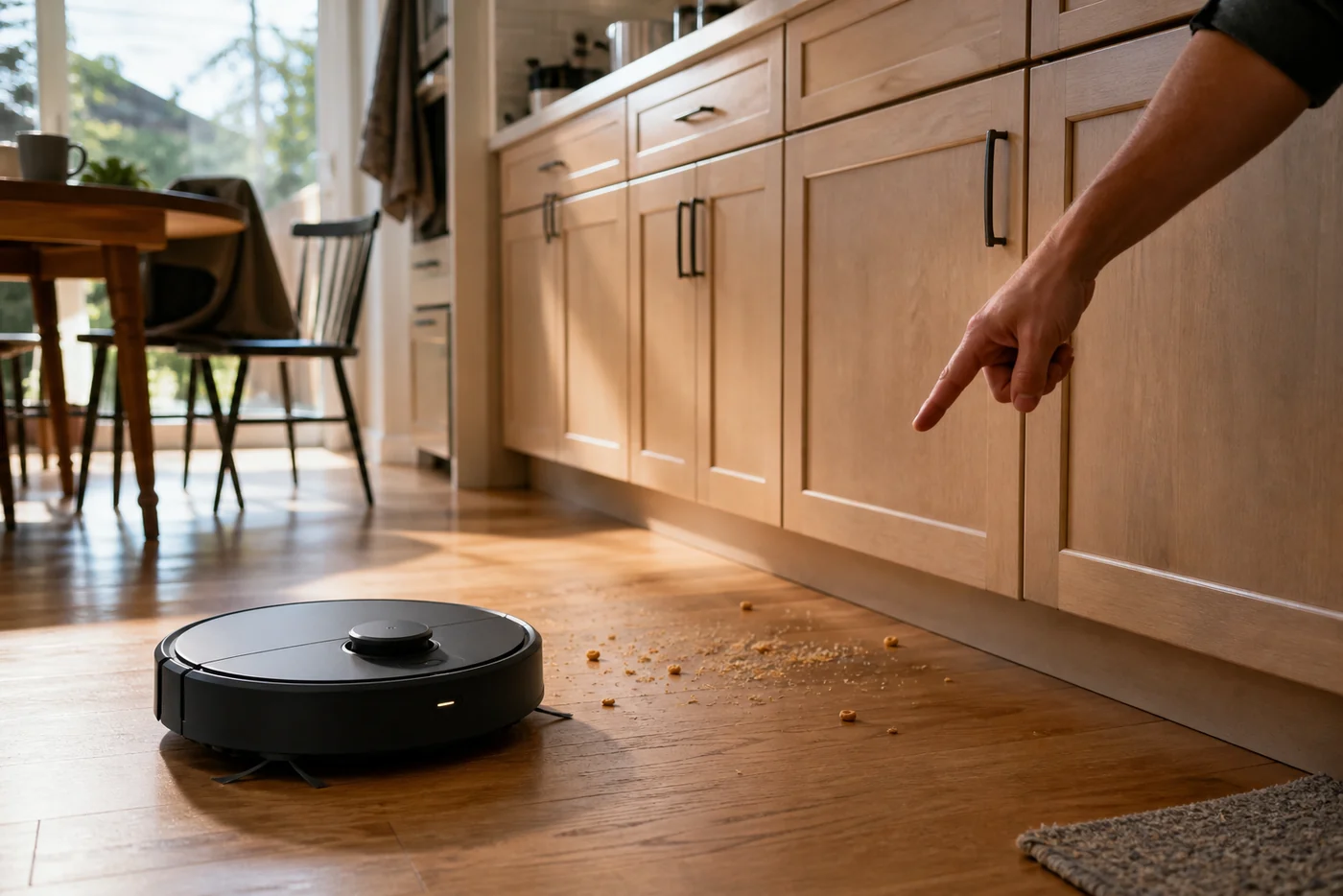
What Matic Cues can do
Matic Cues rolled out on August 13 as a free software update for existing Matic owners and will ship on new units. The robot can respond to natural-language instructions in more than 70 languages. People can ask it to vacuum one room, mop another, return to its dock, follow them or clean a spot they point toward.
The Verge’s Jennifer Pattison Tuohy tried commands including cleaning the inside of a rug while avoiding its tassels and chaining several rooms into one job. She found the voice assistant responsive and the pointing feature more useful for quick spot cleaning than drawing a zone on a phone map. From standing height, though, her gesture selected a wider area than she intended; crouching produced a tighter target.
Gizmodo’s Wes Davis poured cornmeal onto a kitchen floor and put paper scraps on a rug. The robot sometimes backed up or asked him to step away so its cameras could see the gesture, then cleaned the indicated area. His test also exposed an important limit: Matic was not looking at the floor and recognizing the cornmeal as a mess. It was spot-cleaning the place he pointed to.
That distinction keeps the product claim honest. “Clean this” currently means “clean around this location,” not “understand this object, decide it is dirt and remove exactly that.” The first version is still useful. It just needs a person to point.
A home robot should not need one trained owner
Robot vacuum apps are fine for schedules, maps, room labels and cleaning history. They are clumsy for the mess happening right now. They also turn one person into the household administrator: the one with the account, the map and the patience to remember which menu contains spot cleaning.
Direct voice and gesture control gives the chore back to the room. A child who spills cereal, a grandparent who does not have the app and a guest who notices crumbs can all ask for the same small job. Nobody needs the owner’s phone. Nobody needs a tutorial before the floor gets cleaned.
The pointing part helps because spoken directions inside a home are often vague. “Over there” is useless to a map. A finger adds the missing location. Matic turns toward the speaker after the wake phrase, uses its five-camera vision system to read the gesture and resolves that direction against the space it has mapped.
This is a narrow feature, and that is part of its appeal. The robot is not planning dinner or pretending to be a family member. It is taking one ordinary cue from a person in the room and moving a real chore forward.
The voice shortcut adds a cloud connection
Matic has sold its robot around on-device vision and the ability to work without an internet connection. Gesture recognition still runs on the robot. The new flexible voice commands do not.
The company says the “Hey Matic” wake phrase is handled locally, but the words that follow are sent to the Gemini API. The Verge reports that a short chime marks when information is leaving the device, commands are anonymized, Matic Cues is opt-in and the microphones can be turned off in settings. Matic says it plans to move the 20 or 30 most common commands onto the robot later.
That trade is understandable: cloud language processing supports many languages and lets people speak more naturally than a fixed command list. It also means a feature designed to remove the phone now depends on an internet service. Gizmodo notes that this is the first Matic capability that cannot work through the robot’s otherwise local Bluetooth connection alone.
A spoken command and a pointing gesture are not interchangeable here. If the internet is down, the robot may still see the gesture but cannot interpret the flexible request that tells it what to do. Owners should know which part is local before treating “no app required” as “no cloud required.”
Try the one-week kitchen test
If you already own a Matic, skip the polished demo and try Cues in the room that produces the most small messes. Use it for a week in the kitchen after breakfast or dinner. Let different people ask for the cleanup instead of having one app-savvy person run every attempt.
Change the conditions a little. Point from standing height and from closer to the floor. Put a chair near the target. Ask in the language and phrasing each person would normally use. Try one chained job, then a quick spot clean. On one attempt, turn off the internet and see what remains available rather than learning during the next outage.
Keep the score plain: did it start the right job, clean the intended area and finish without someone reopening the app? Also count rescues. A follow-me command that loses the person around a chair, a gesture that selects half the kitchen or a request that silently fails has not removed the interface. It has hidden the interface until something goes wrong.
The week is a pass if more people can handle their own small messes and the household’s usual robot expert gets fewer interruptions. If everyone still calls the same person over, the gesture looked good but did not change the chore.
Ren watches the body language. Cass watches the boundary.
Ren Ortiz likes that the robot has to combine a person’s location, pointing direction and room map before it moves. His test is a lived-in kitchen, not an empty demo floor: move a chair, let someone point from farther away and have a dog cross the path. If the robot loses the person or cannot resolve the gesture, stopping and asking beats cleaning a much larger area.
Cass Bell sees a smaller promise inside “no app required.” The daily command can skip the app, while opt-in, microphone settings and privacy choices still live there. Voice after the wake word also leaves the home for cloud processing. A guest should be able to tell when that happens, and the owner should be able to disable it without turning household privacy into another scavenger hunt.
Ren is testing whether the physical shortcut survives a messy room. Cass is checking whether convenience quietly widens the data boundary. The feature earns trust only if both answers stay easy to see.
Useful interface, expensive robot
Matic Cues is a free update, but the robot itself costs $1,245. The Verge and Gizmodo report that the price is scheduled to rise to $1,495 on September 9. Pointing at crumbs is not enough reason to rush a four-figure purchase.
If you are considering one, judge the whole machine: cleaning quality, obstacle handling, maintenance, noise, repair and how well it deals with the particular rugs, thresholds, cables, pets and furniture in your home. Then treat Cues as an accessibility and shared-use benefit, not a substitute for those basics.
The update still lands on a sensible product truth. A home robot becomes more useful when the person standing beside the mess can direct it immediately. Fewer maps, fewer menus, one less reason to find the phone. For this particular chore, that is enough progress.