
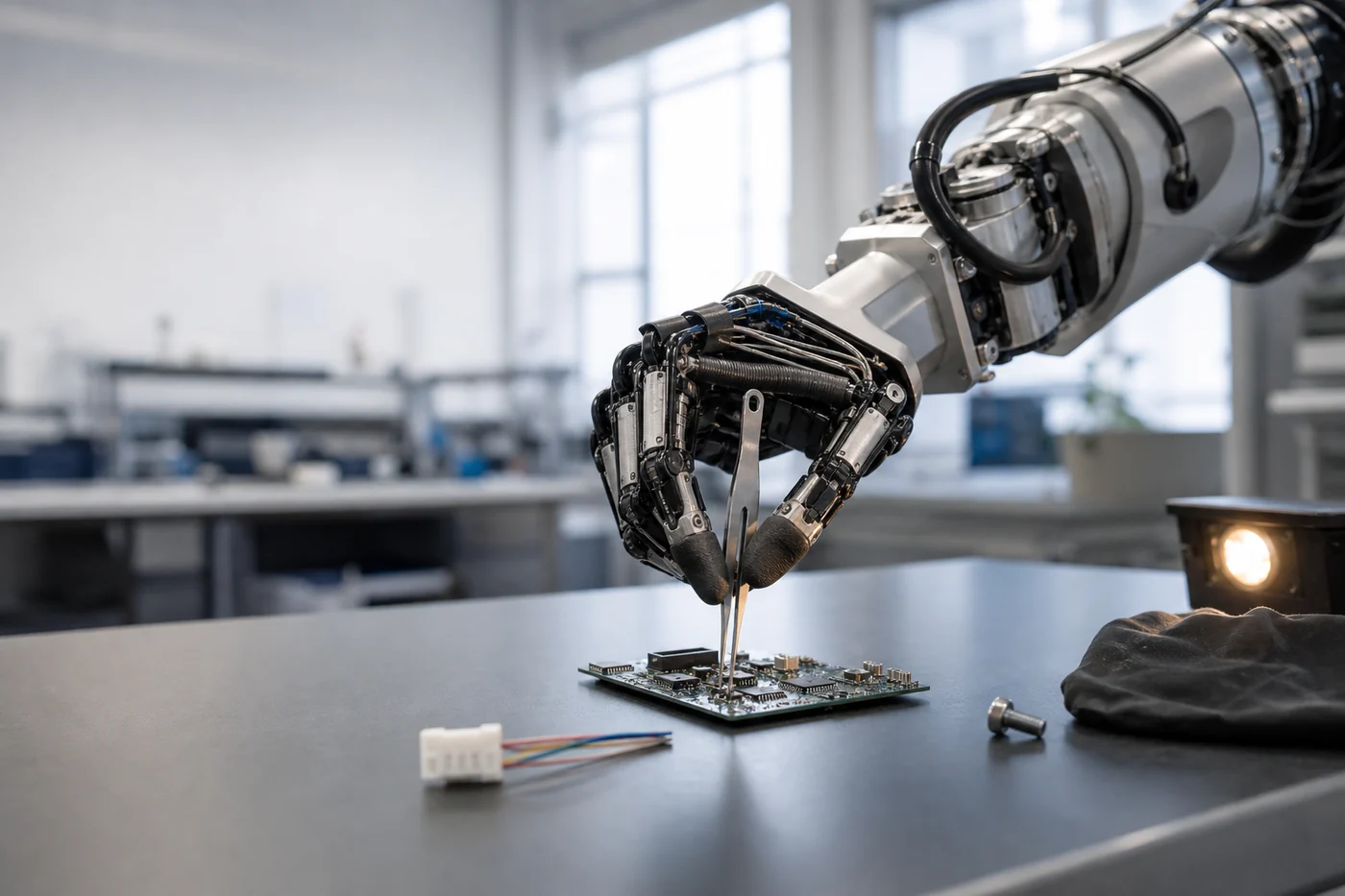
Why build five fingers when two often work?
Two-finger grippers are excellent when the objects, positions and motions are predictable. A factory can shape the station around the gripper, feed it identical parts and get years of reliable repetition. The trouble begins with flexible wiring, soft packaging, small fasteners, tool use and mixed objects that arrive in slightly different poses.
Mimic says the M1 has 15 actuated degrees of freedom across 21 joints, including an opposable thumb and side-to-side finger movement. Its motors sit in the forearm and pull tendons through the hand. That keeps mass out of the fingers and lets the actuators sense force as well as drive motion. The company's broader technology page lists tactile and position sensing, a 7-kilogram payload and plus-or-minus 0.5 millimeter fingertip precision.
Those specifications explain the ambition, not the reliability. A hand can look graceful for one filmed attempt and still be miserable over an eight-hour shift. Tendons stretch. Gloves wear. Fingertips get dirty. A slightly bent connector changes the contact. The real product is the hand plus all the quiet recovery between successful grasps.
The clever part may be the thing a worker wears
Robotics has a data problem. Language models learned from an internet full of words. There is no comparable public archive of precise finger positions, contact forces and tool movements. Teams usually collect that data by having people teleoperate real robots, which means the machine, the work cell and the trained operator all have to be available at once.
Mimic's U1 takes a different route. The rigid wearable constrains a person's hand to movements the M1 can reproduce, while encoders, tactile sensors and a wrist camera record the demonstration. The company argues that this produces robot-compatible training data without putting a robot in the factory first. In an earlier technical essay, Mimic estimated its wearable collection method was about five times cheaper and seven times faster than conventional teleoperation. Those are company figures, not an independent benchmark.
This also explains the human-shaped hand. Mimic is not saying every robot needs a face, legs or a torso. It is saying the training source is human hands, so matching the hand reduces the translation problem. The company is openly anti-humanoid about the rest: use a standard arm or mobile base when that is enough.
What this could change for skilled manual work
The first jobs are unlikely to be dramatic. Think threading a cable through a tight route, placing an irregular component, opening a pouch, aligning a small part or changing grip halfway through an assembly. These are the jobs that sit between fully manual work and traditional automation because they change too often to justify a custom machine.
A teachable hand could lower that barrier. The person who already knows the task demonstrates it in the real setting. The system learns the motion and contact pattern. The robot then handles the repeatable portion while the worker deals with exceptions, setup and judgment.
But 'learn from the worker' can hide a bad bargain. If demonstrations are constantly requested, failed runs interrupt the same expert and every object change triggers another data session, the machine has not removed the fiddly work. It has turned the skilled worker into unpaid training infrastructure. A good deployment should reduce interruptions over time and make the remaining failures easy to diagnose.
The factory test is boring on purpose
Do not grade a dexterous robot by the best clip. Give it a mixed tray at the start of a shift and inspect the last hour. Count clean grasps, retries, drops, damaged parts, tool slips, glove changes and minutes of human rescue. Then change lighting, object orientation and one material property. That is where a general hand earns the word general.
The hand should also show why it stopped. Too much force, uncertain contact, object slipped, camera view blocked and expected part missing are different problems. A worker standing at the bench needs that difference before reaching into the cell. 'Task failed' is software language dumped onto someone else's body.
Mimic's full-stack design gives it a chance to connect those signals because it owns the hand, wearable and models. It also concentrates the burden of proof. The next useful evidence is not another dexterity montage. It is a week of ordinary work with the failures left in.
Two views from the workbench
Priya Rao would measure whether dexterity survives repetition. Her comparison starts with the same mixed-part task done manually and with the robot: accepted parts, damaged parts, retries, rescue minutes and interruptions to the person who taught it. A faster cycle is not a win if the expert spends the afternoon fixing edge cases.
Mina Torres is watching the job around the machine. If teaching the robot captures a worker's technique, the worker should know what was recorded, how it will be used and whether the skill changes their role, schedule or pay. 'We learned from you' should not become the polite sentence said just before the person loses control of the work.
Both views lead to the same practical question. Does the hand leave the person with less strain and fewer repetitive motions, or does it create a new stream of rescues and training requests? The answer will matter more than how human the fingers look.