
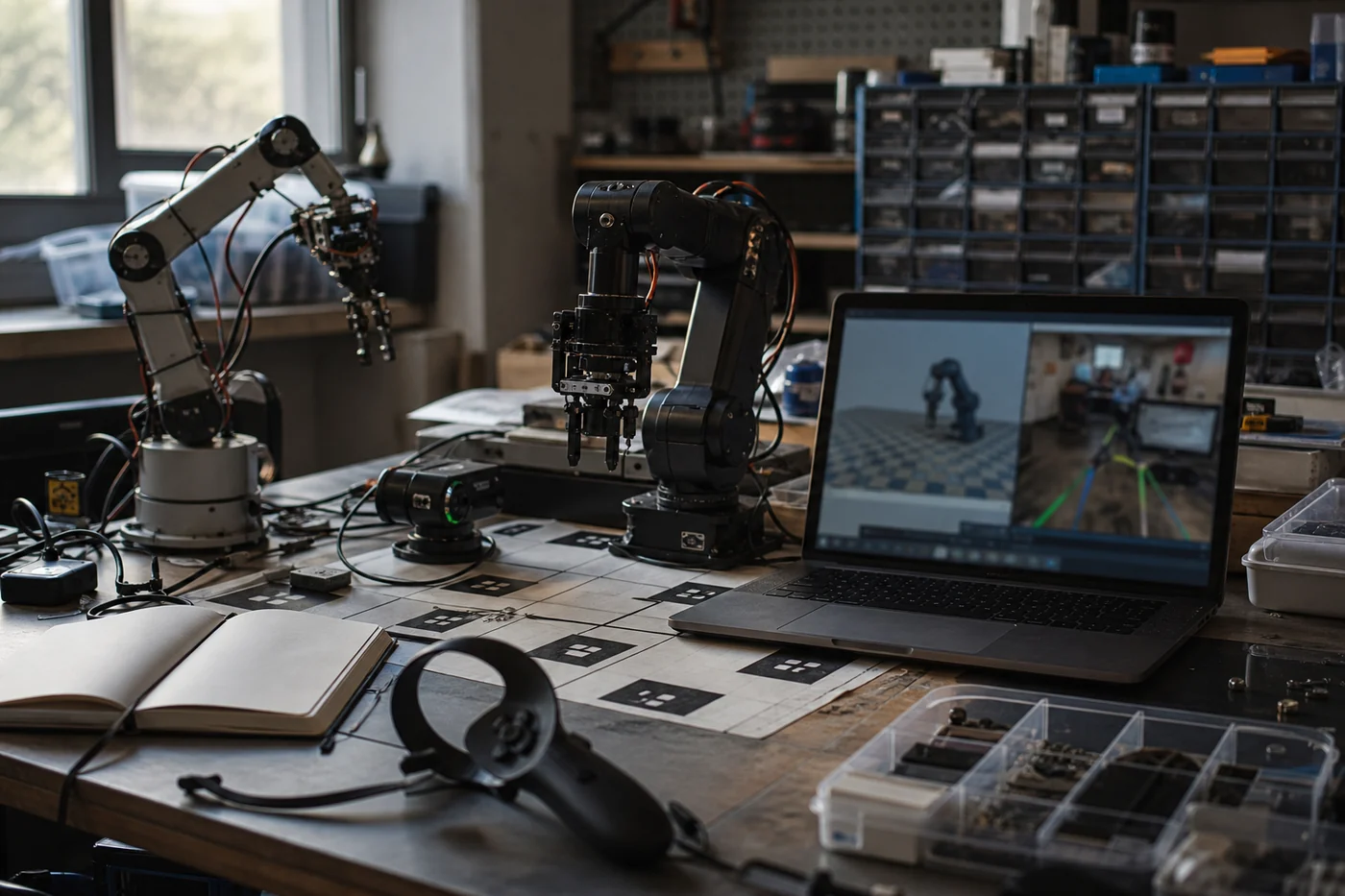
The claim is about the bench, not the room
The NVIDIA blog frames the LeRobot work as a way to make physical AI development less gated by fragmented datasets, robot models, simulation tools, compute, and validation systems. The concrete pieces matter: Isaac Teleop for collecting human demonstrations, GR00T 1.7 for a starting robot policy, Isaac Sim and Isaac Lab for simulated testing, Lab-Arena for registering environments, and Jetson Thor support for deployment on open robots such as Reachy 2.
Hugging Face’s LeRobot project is already aimed at the same boring bottleneck: a common Python-native interface for robots, a standardized dataset format, shared policies, evaluation scripts, and hardware support that ranges from low-cost arms to humanoids. The GitHub repository describes LeRobotDataset as synchronized video plus state/action data, stored in formats that can be hosted and shared through the Hugging Face Hub.
That is not the same as saying robots are ready for your office, factory, or kitchen.
It means more teams can start the experiment from a shared workbench instead of spending weeks proving their cable pile can talk to their training script.
GR00T 1.7 is a starting point, not a receipt
The technical post gives the strongest version of the source claim. NVIDIA says GR00T 1.7 is a 3B-parameter, Apache-2.0 model using a Cosmos-Reason2-2B backbone, pretrained on about 32,000 hours of real human demonstration and egocentric data plus about 8,000 hours of simulated rollouts and demonstrations. It reports improved DROID and SimplerEnv benchmark results over the previous release, including DROID-F0 up 10% and DROID-F6 up 61%.
Those numbers are useful. They are not magic.
A robot policy can improve on a benchmark and still fail at the part a worker actually feels: a bumped camera, a bad grasp, a reflective object, a blocked path, a calibration drift, a lighting change, or a reset that quietly becomes somebody’s new job. Theo’s rule here is simple: separate the training loop from the deployment claim.
The open model lowers the cost of trying. The floor still gets a vote.
The practical developer change
The win for developers is less time gluing incompatible robotics tools together before the first real test. A shared loop lets teams spend more energy on task design, data quality, evaluation, and deployment reality.
What this means for people who just want robots to help
Open robotics tools matter when they make claims easier to inspect. People do not need another perfect clip. They need to know whether the robot removed work, created cleanup, or handed a new babysitting job to someone nearby.