
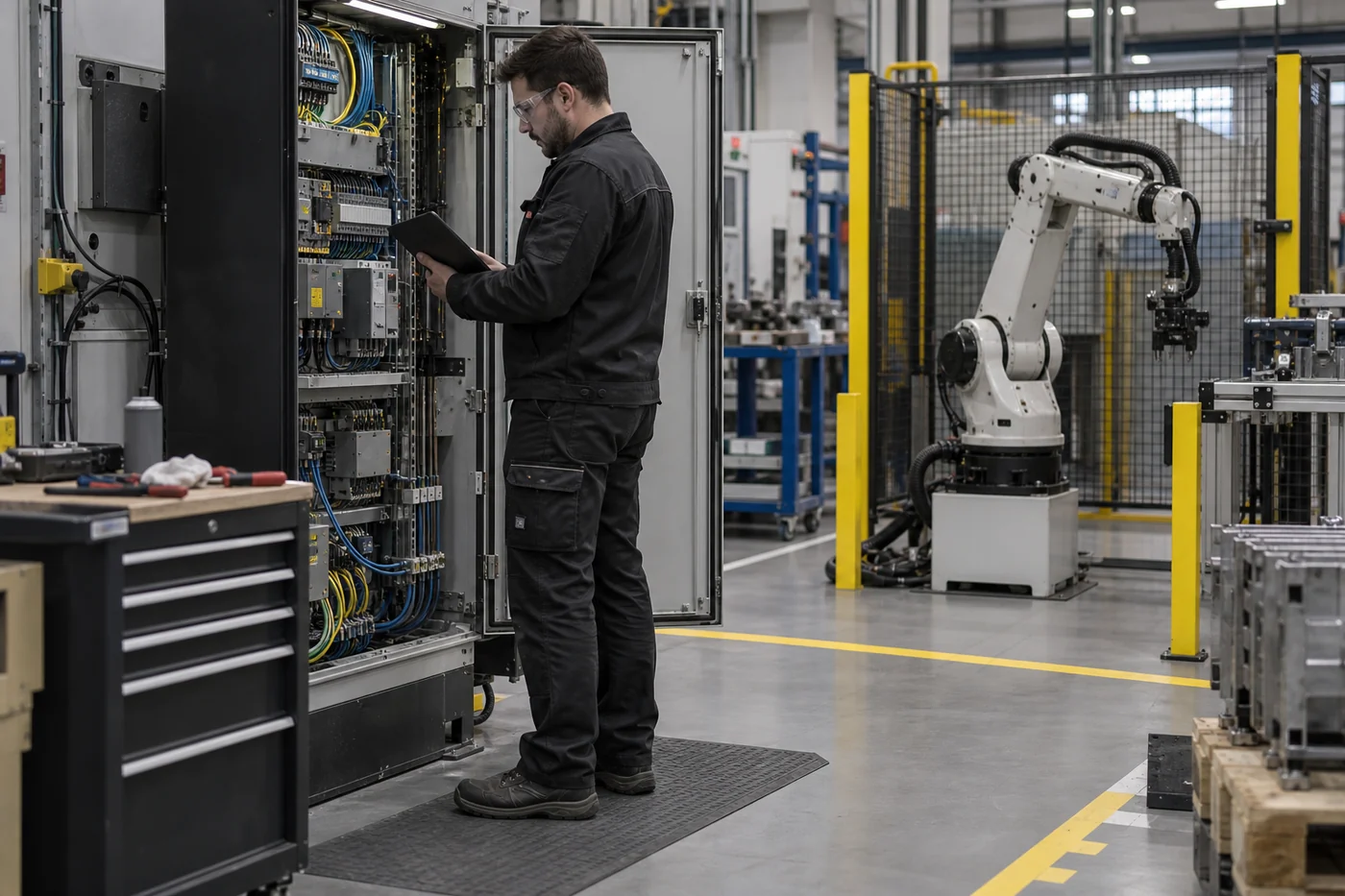
The technician is not just there to tighten bolts
The newly recognized Chinese role covers more than conventional maintenance. Reporting on the classification describes work that can include deploying and commissioning hardware and software, collecting multimodal robot data through teleoperation and simulation tools, monitoring performance, diagnosing faults and adapting models. National standards are planned to guide vocational education, skills training and assessment.
That combination makes sense. A robot can fail because a belt slipped, because a controller lost a setting, because lighting changed what a vision system sees, or because the learned behavior is wrong for this site. The person at the machine needs enough range to tell those cases apart. Sending every odd movement to a remote specialist is an expensive way to discover the system does not fit ordinary work.
The United States already recognizes Robotics Technicians in O*NET. Its task list includes installing, programming, repairing and calibrating robots, as well as training robots with AI software or interactive techniques. The work is here already. What is changing is how many disciplines are landing in the same role.
A new title does not create a ready workforce
China added 11 occupations in this round, five classified as digital. Xinhua says the ministry expects a sizable shortage of workers with digital skills to persist and plans standards for training. Recognition is a useful signal to schools and employers; it is not a shortcut to someone who can safely recover a stopped machine on Tuesday afternoon.
For a buyer, that distinction belongs in the spreadsheet. The price of a robot is not just hardware, software and a service contract. It includes who learns the line, who covers a shift, what they are allowed to change, and whether a local person can separate a safe pause from an urgent call for help.
This is especially true for smaller factories and warehouses. They may not have a deep automation team waiting in the next room. A system that needs the original vendor to interpret every alert can turn a promising labor-saving purchase into a new queue of tickets and visits.
What a sensible first pilot looks like
Start with one repeated job where the finish is visible: moving a defined tote, tending a machine, checking a known defect or transporting materials along a fixed route. Write down the normal exception cases before launch—the blocked path, wrong part, bad scan, missing item and sensor fault—not after someone has been improvising them for a month.
Then give the people nearest the work a simple record: what the robot tried, why it paused, what they changed and whether the robot finished the task after that change. This is not paperwork for its own sake. It prevents the same mystery from being rediscovered by the next shift, and it shows whether the system is removing work or merely moving diagnosis onto someone else.
Finally, measure the whole job. Uptime matters, but so do rescue minutes, restart time, quality misses and the time a supervisor spends explaining the machine's state. A robot that moves boxes quickly but makes a lead walk over six times a shift has not yet given the team much time back.
Ren and Mara are looking for different evidence
Ren Ortiz wants the physical state to be legible on the floor: which machine paused, what it saw, whether a person can safely approach it and what needs to change before it moves again. A status light that says only “error” does not help the person standing beside the robot decide whether the problem is a loose label or a blocked safety zone.
Mara Vale is less interested in the job title than in the staffing promise underneath it. If a company sells flexibility, the buyer should ask who is trained to make the change, what that training costs in paid time, and whether the role has enough authority to stop a bad setup before it turns into a production target.
They point to the same thing from different directions: a robot is not finished when it can perform the happy path. It is finished when an ordinary team can live with its imperfect days without losing the afternoon to it.