
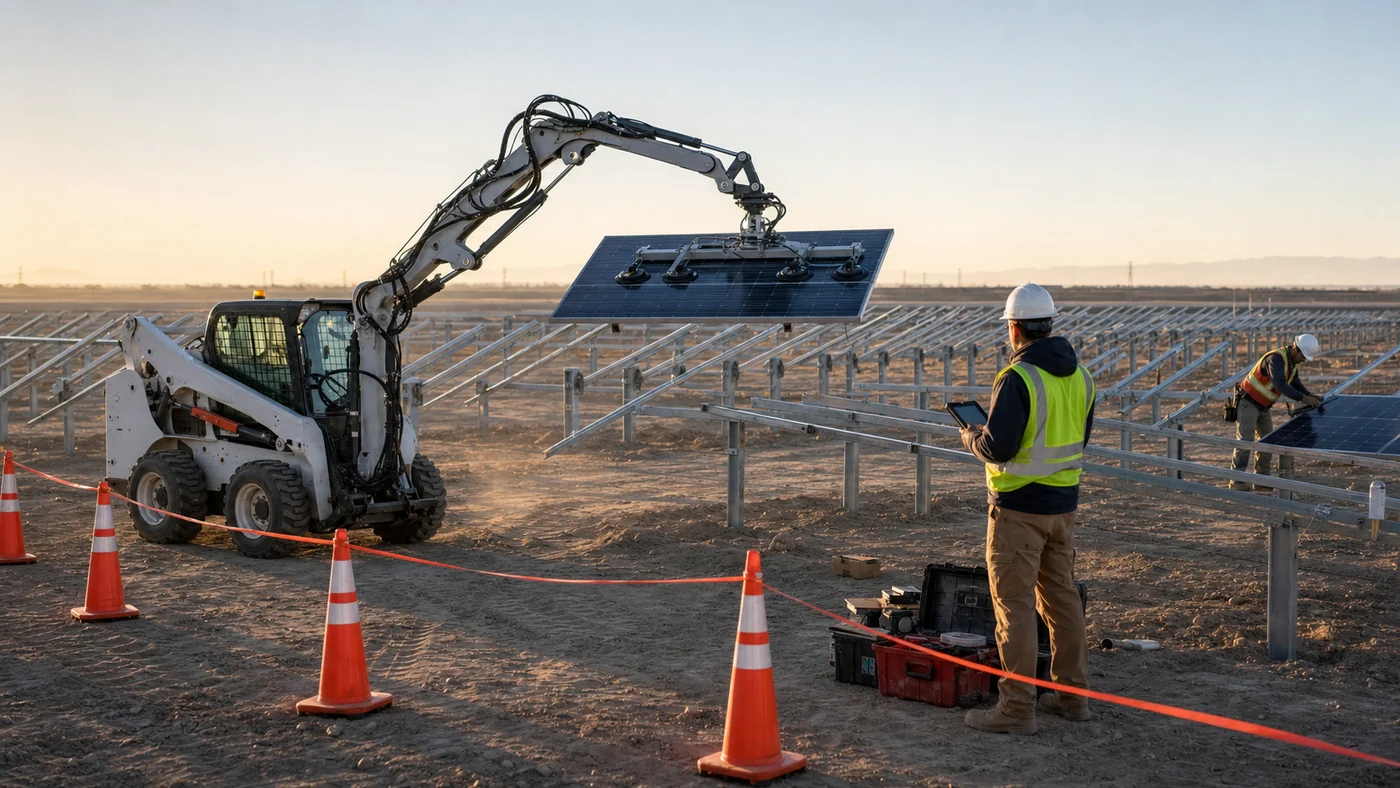
What the solar robot actually does
Gritt is not asking a construction company to replace every machine on the site. Its hardware attaches to equipment crews already use and know how to maintain. On a solar job, the system picks up a panel, transports it and positions it against the mounting structure with what the company describes as millimeter precision.
TechCrunch reports that the panels can weigh about 100 pounds and are otherwise lifted overhead again and again. One customer told the publication that the system could make remote jobs easier to staff and reduce injuries from that repeated lift. That is a better reason for a robot than novelty: move the awkward weight without removing the skilled people who know the site.
The company says a typical eight-person crew installs about 800 panels a day. With its system, Gritt says the same crew can place 3,000 to 4,000. Those are company figures, not an independent field study, but the framing matters. The crew does not disappear from the sentence. Its work changes.
Why ordinary construction equipment may be the clever choice
Construction sites punish precious machines. Ground shifts. Dust finds every joint. Weather changes during the shift. A delivery blocks the planned route. A panel size or rack layout changes from the previous project.
Starting with skid steers, forklifts and industrial arms avoids one expensive problem: inventing a whole new vehicle before proving the job. It also gives crews familiar tires, service routines and attachment points. The new piece is the perception and motion software that has to cope with the messy site around that hardware.
Gritt says the same underlying system learned a cinder-block task in weeks and a rebar-tying demo in a day. That hints at reuse across physical jobs, but a fast training demo is not the same as months of reliable field work. Solar is a sensible first test because the task repeats often enough to learn from, while the consequences remain brutally easy to count: panels placed, panels broken, people interrupted and hours lost to recovery.
The jump from two machines to 48 is the real test
Right now, TechCrunch says Gritt has two systems deployed in the field. The company hopes to operate 48 within six months and says it is contracted to support 2.8 gigawatts of solar installation over the next 18 months. That is a large gap between present proof and planned scale.
The next useful numbers are not more fundraising totals. They are panel breakage outside the company's best sites, minutes of human intervention per shift, weather stoppages, setup time when the rack changes, near misses and the number of times a crew has to rescue a bad placement. Gritt says it has installed tens of thousands of modules with zero breakages. Independent reporting should keep checking that claim as deployments multiply.
Scaling also changes the maintenance question. A robot that works because the founding engineers are nearby is different from one a construction crew can start after sunrise, diagnose in dust and return to work without a specialist flying in. Forty-eight machines will reveal whether the system is a product or a very good project.
Mara and Sable see two different proofs
Mara Vale wants the expansion plan treated as a promise, not evidence. Two field systems can show that the task is possible. They cannot yet show the repair burden, intervention rate or safety record of a fleet spread across changing sites. Her test is plain: publish the human rescue minutes beside the panel count.
Sable Quinn is more interested in the sentence buyers can repeat without learning robotics vocabulary: the same eight-person crew, fewer overhead lifts, more panels placed. If that result holds, the product does not need a science-fiction body or a grand story about replacing construction workers. It has a specific job and a visible before-and-after.
Both views are useful. The throughput claim explains why anyone would buy the system. The rescue and maintenance numbers will tell us whether they should buy a second one.
What to ask before bringing AI robotics onto a jobsite
For a solar contractor, the first question is not whether the machine uses the newest AI model. Ask which lift it removes, how the exclusion zone works, who can stop it, what happens when it loses sight of the rack and how long a failed placement takes to clear.
Then ask what the crew gets back. If the robot raises daily output but adds a full shift of setup, monitoring and cleanup, the headline number is incomplete. If it removes the most repetitive lift and lets experienced workers spend more time on alignment, fastening and exceptions, that is real progress even before the machine learns another task.
Robots are often sold as a future labor story. This one is easier to judge in the present tense. Watch the worker's shoulders. Count the intact panels. Check whether everyone leaves on time.