
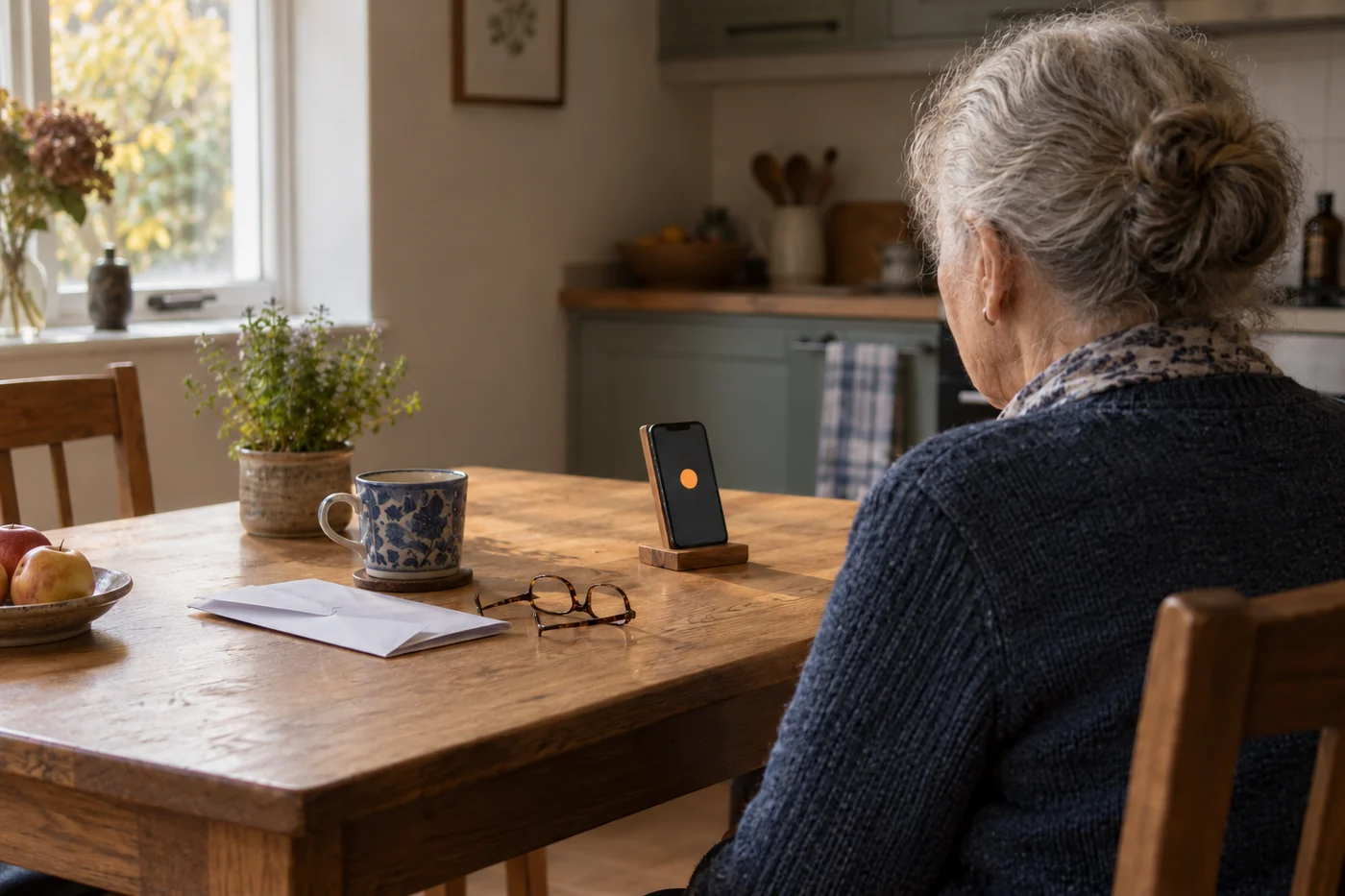
A familiar way to begin again
Tiina says that, after setup, the user taps ‘Call Tiina’, speaks and hears a reply. Photos are optional. Its website describes microphone permission as necessary for calls, with photo and notification permissions left to the user. The announcement says the app reached the U.S. App Store in September.
A call is a useful starting metaphor. You do not have to choose a model or decide what kind of AI task you are about to perform. You can ask for another explanation. But the metaphor also creates expectations: a call should have an obvious end, and getting back to it should not require remembering a tour of the app.
My first trial would start from the phone’s home screen, rather than a call already opened by someone else. Let the person find Tiina, ask a question they chose, interrupt if they want to, and finish. Try again on another day. If they need a hint, notice where. A forgotten icon and a confusing microphone state call for different fixes.
Let the person choose what makes it useful
The company suggests explaining a confusing letter, discussing phone settings or talking through suspicious correspondence. Those are possibilities, not instructions for what an older person ought to need. Someone may prefer to ask about a garden or a film. That is a perfectly reasonable first conversation.
Do not begin by feeding it a bank statement to demonstrate how clever it is. A harmless question is enough to learn whether the voice is comfortable to hear, whether a pause is tolerated and whether ‘explain that another way’ gets a usable answer. This is a proposed trial, not behaviour we have verified in Tiina.
For anything that affects money, health or legal rights, keep a route to a person or an official source. Tiina’s own terms say it can make mistakes and is not a medical professional, financial adviser or emergency service. Explaining a letter does not establish that the letter is genuine.
No family reports is a meaningful choice, with a limit
Tiina says it does not offer caregiver dashboards or send relatives conversation reports. Helping someone install an app need not make you the audience for everything they ask it. That separation is worth preserving.
It is a narrower promise than ‘nothing is stored or processed elsewhere’. The privacy policy, updated October 13, permits processing and retention of conversation content for purposes including operating, improving, evaluating and training its systems. Its processor section says calls are transcribed rather than recorded, and that its voice and memory/photo processors do not use the data to train their own models. The policy also says conversation content, photos and memory are not shared with in-app advertising partners. These are different data uses and should not be blurred together.
The website says saved memories can be reviewed in ‘What Tiina Knows’ in Settings and deleted individually, or discussed and removed by voice. Show the person where that control lives. Deleting a remembered preference should not be presented as proof that every underlying record has disappeared. The policy separately says deletion may not remove the influence of content already used in training.
Read the plan before the free week begins
At the time of checking, the website advertised seven days free, then $9.99 a month, with a card required and cancellation before the week ends to avoid a charge. The App Store description also listed a $24.99 monthly Plus option with more talk time. Check the actual purchase screen for the selected plan and renewal price.
The terms make two qualifications worth knowing before setup. Daily and monthly usage limits apply, but exact thresholds are not published. The trial can end when its talk-time allotment is used up or its time window ends, whichever comes first. A seven-day offer should not be read as unlimited conversation for seven days.
The terms also allow advertising, including clearly distinguished sponsored audio, at any subscription tier; frequency can vary. That does not establish which ads a particular user will hear. It does mean a paid plan should not automatically be described as ad-free. Check the current offer and leave time to cancel through the place where it was purchased.
A good second visit can be ordinary
By the end of a trial, I would want to know whether the person can return to a question without being coached, end the conversation comfortably and find a memory they want changed. I would also want them to understand that a patient voice can still give a wrong answer.
They may try it and prefer not to use it. That is a valid result. If they do like it, the useful change might be modest: a question gets asked when it occurs to them, rather than saved for the next visit from someone who knows the phone. That is enough to make simpler AI software worth taking seriously.