
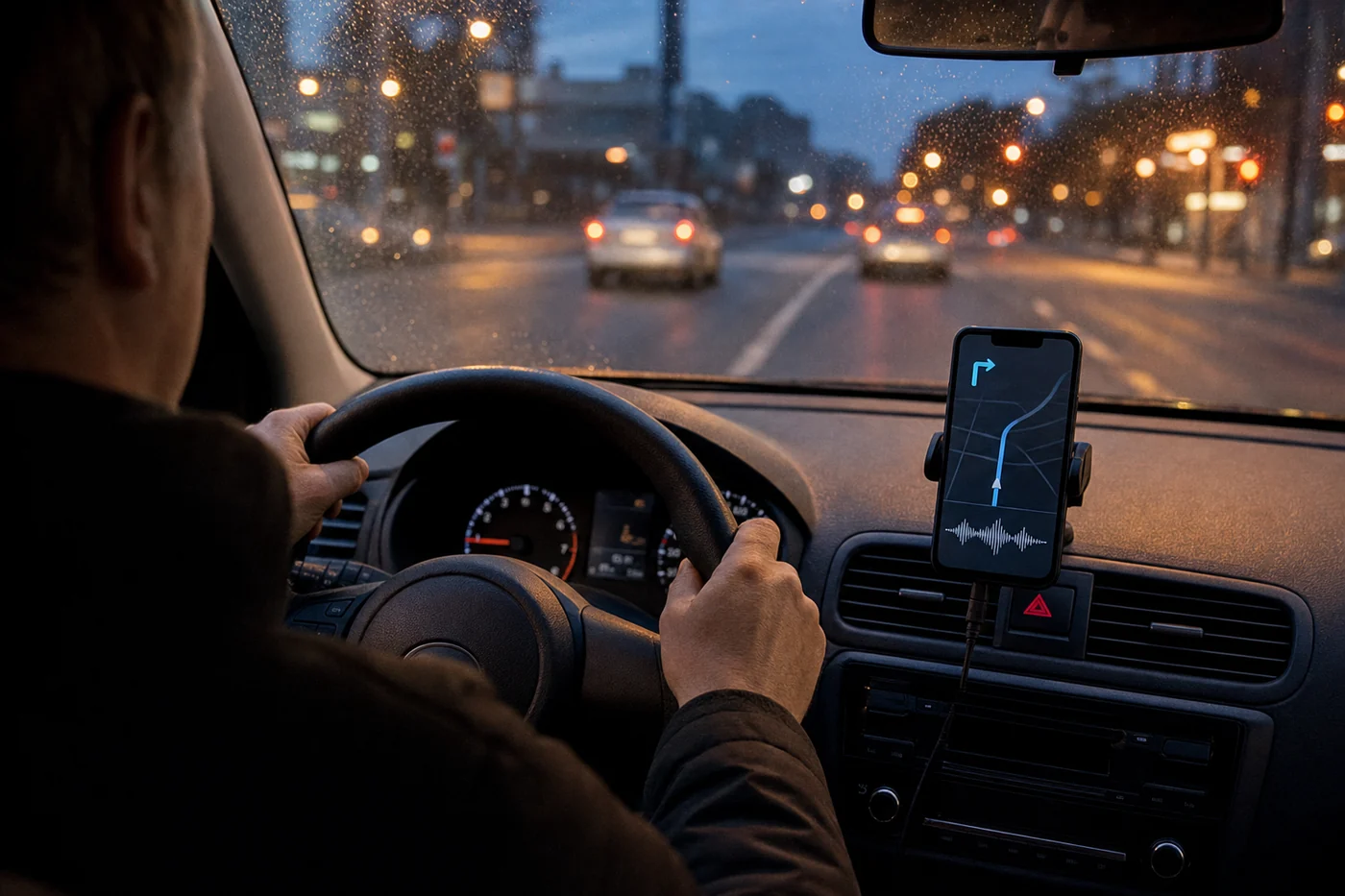
A quiet setting inside a busy release
The larger Waze update has plenty of obvious AI features. Drivers can say that a road is closed or an address is wrong, and Waze will send the suggestion to local map editors for verification. Beta users can describe the place they need — cheap gas nearby, an open coffee shop, parking near a mall — instead of naming a destination first.
Waze will also suggest routes based on previous trips. Someone who usually takes the highway instead of a stop-heavy local route should see that preference reflected in the options. Personalization and less chatty mode are rolling out globally; the destination chat remains in global beta, and motorcycle mode begins in seven countries.
The quieter voice option is easy to overlook because it does not look like a smarter assistant. It looks like restraint. The app still speaks when the road demands it, then gets out of the way. For a person trying to follow directions, hear a podcast, notice a siren, or simply think, that subtraction may be more useful than another conversational trick.
Hands-free still uses attention
Voice is usually better than tapping through a screen while driving. It is not free attention.
A 2024 on-road study of 28 drivers ages 18 to 25 compared speech controls with visual-manual controls for calls, music, navigation, and radio. Speech was less distracting across most measures, but both modes created distraction compared with baseline driving. Navigation and music were the most demanding tasks in the study.
Older research from the AAA Foundation for Traffic Safety reached a compatible conclusion: hands-free does not mean risk-free. Its work found that interaction duration and speech-recognition accuracy were central to cognitive demand. Simple car commands could be relatively low-demand, while longer exchanges and error correction pushed the workload higher.
That does not prove Waze's less chatty mode makes anyone safer. Waze has not published a before-and-after safety result for the feature. It does explain why shorter, less frequent prompts are worth measuring rather than dismissing as a cosmetic preference. The assistant may have a natural voice and perfect timing in a demo. The driver still has one brain.
Personalization should remove corrections, not choices
The personalized-route feature carries a different promise: fewer little arguments with the map. If a driver rejects the same local shortcut every morning, the app can stop putting that route first. Fewer overrides could mean fewer taps and less irritation.
But a route history is not always a preference. A person might take one road because of school drop-off, a temporary construction closure, a weekly appointment, or a passenger who gets carsick on another route. Yesterday's pattern can be useful evidence without becoming today's command.
Waze keeps alternate routes available and lets users turn personalization off. That choice matters. A good personalized map should make the likely option easier to find while still showing what changed: a faster route, a familiar route, a toll, an unfamiliar road, or a hazard. The point is to reduce unnecessary correction, not to make the app's guess harder to inspect.
Two views from the passenger seat
Noah Park would keep the trial cheap and concrete: use the same commute, leave the phone mounted, and log only the moments that made a hand move or a turn go wrong. If the quieter mode needs a complicated measurement ritual, the test has already become another chore.
Mina Torres would protect the difference between silence and abandonment. Fewer prompts should mean the app stopped narrating obvious stretches of road, not that it went vague before the exit a tired parent cannot afford to miss. The user should not have to watch the screen to learn whether quiet mode is still doing its job.
Those views pull in the right directions. One asks whether the feature removes actual friction. The other asks whether the remaining guidance still arrives at the human moment that matters. That is the bar for calm technology: fewer demands, no new guessing.