
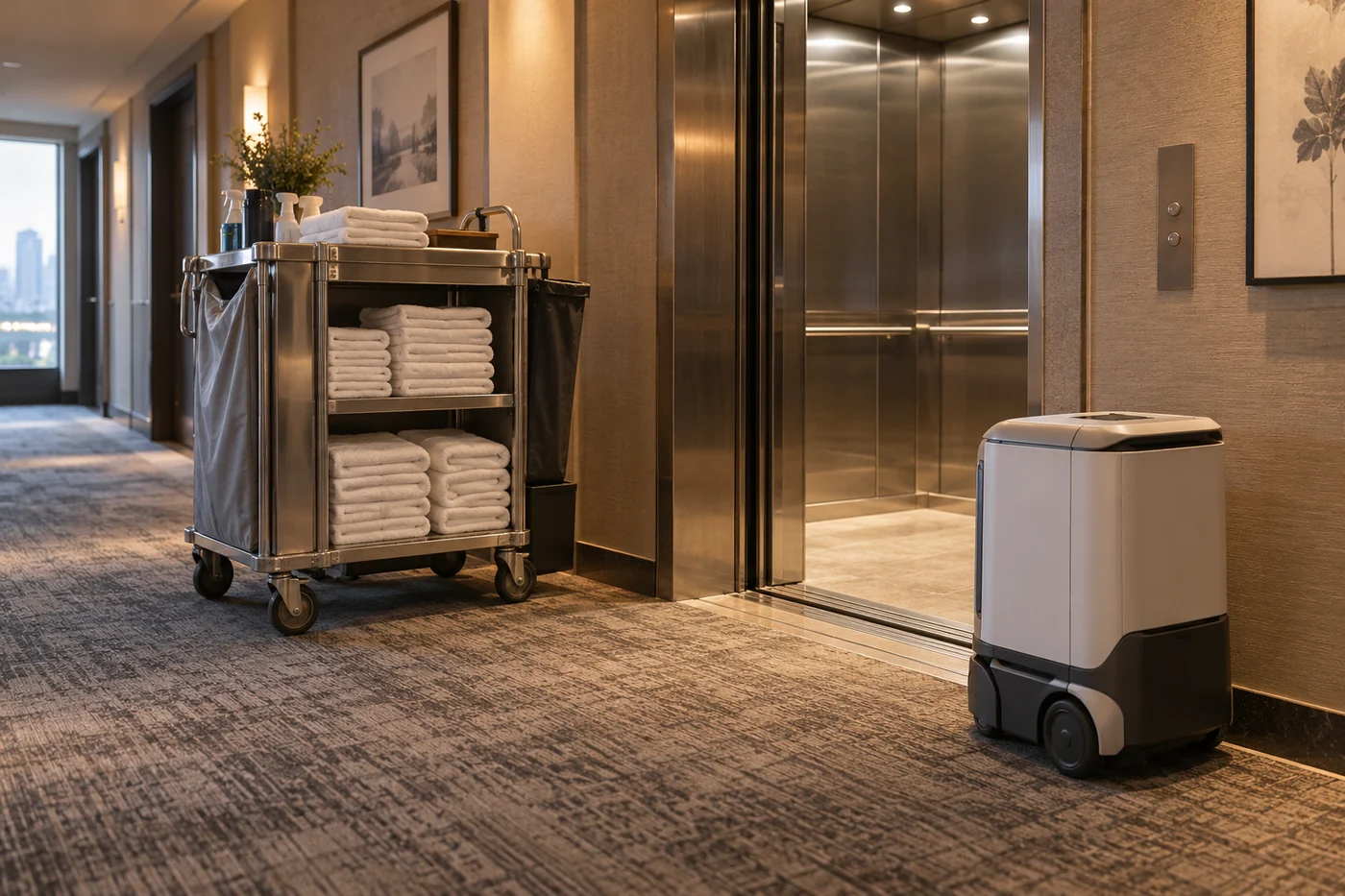
The first jobs are around housekeeping, not a replacement for it
The release names guest-amenity and in-room dining deliveries, restaurant and banquet transport, scheduled cleaning of selected public areas and corridors, and support for directions and basic enquiries. Check-in assistance still needs separate assessment and approval. Individual robot assignments will be finalized before launch.
Those are worthwhile jobs. A worker trying to finish a room can lose time fetching something from another floor; a restaurant team can spend much of a service carrying items between spaces. A machine that takes a repeated trip off someone's hands does not need to make beds to be useful.
But none of that establishes that a robot can turn over a guest room. Consider the ordinary judgment involved: a charger left beside a bed might be lost property, a stain might need a different treatment, and a room may need to stay untouched until a guest leaves. These are examples of the decisions room attendants face, not documented capabilities or failures of the planned machines.
A helpful robot needs a building it can get through
Before the Singapore rollout, the partners say they will prepare lift integration, mapped routes, network requirements and guest arrival notifications. That work determines whether the robot can finish a trip without sending someone after it.
There is a concrete example elsewhere. Schindler describes a Gausium Phantas cleaning robot operating across five floors of the Bauknecht-Quartier in Bottrop. A digital connection lets it call elevators, change floors and return to its charging and fresh-water station. This is a supplier's deployment account, not an independent assessment of labor savings.
Gausium's October 12 explainer also makes a useful qualification: elevator compatibility is confirmed building by building. Cleaning capacity still depends on floor area, available cleaning windows, waiting for lifts and resupply. Buying a robot does not buy an empty elevator at checkout time.
For a hotel considering a trial, I would start with one familiar supply run and include the busiest part of the day. Record who loads it, how long the guest waits, and how many minutes staff spend helping it complete the trip. A quiet-corridor demonstration cannot tell you whether the front desk will inherit a new dispatch job.
The projected saving is not a result yet
YYForce's release projects approximately 10% lower monthly operating costs across selected housekeeping, concierge, and food and beverage operations. It says the comparison includes the robot costs reflected in its model. The scope is those selected operations, not the hotels' total expenses, and the estimate is pre-deployment.
The annex separately mentions a potential 5% reduction in rooms-department overtime costs. That uses a different base. The figures must not be added together, and neither shows a saving already achieved.
The proposed measurements include delivery turnaround, tasks completed per labor hour, reliability, colleague workload and guest feedback. I would want to see the workload measure alongside the cost comparison. Fewer carrying trips could mean a less punishing shift. It could also mean the same shift with more rooms assigned. The announcement does not establish which outcome employees will get.
Teaching the next robot is another piece of work
The later phase would use selected housekeeping and banquet activities to inform YYForce's humanoid development. The release describes permitted observations and agreed use of operational data; it explicitly says this research does not establish readiness to clean occupied guestrooms or run banquets independently.
It also separates rights: YYForce aims to develop proprietary robotics knowledge and datasets, while the hotels retain rights to their operating protocols, confidential business information and brand assets. Use of guest or employee personal data would require separate review and safeguards.
That leaves questions worth answering before observation starts. When is a room attendant teaching rather than simply doing their job? Can they explain why a movement was a one-off workaround? Is teaching time scheduled and paid, and what happens if someone declines to be recorded? The public release does not settle those questions.
I am excited by a robot learning from someone who knows a room well. I would be much less excited if the lesson captured only the movement and lost the reason. Knowing how to lift an object is not knowing whether it should be moved.
Try the carrying job before promising the whole room
A sensible first trial can be small: one repeated delivery, a known route and a clear human fallback. Give the staff who do that work a say in which trip disappears. Compare guest waiting time and staff assistance before expanding the route.
Keep any humanoid research separate in the explanation to staff and guests. A service robot carrying supplies is not evidence that a machine can inspect, clean and ready a private room. The Singapore partnership is a place to test both ambitions over time, not proof that both are available now.
I would happily trade a little lobby spectacle for an attendant who gets to finish what they were doing without another trip upstairs. That is enough of a reason to try the smaller job properly.